
"Our investment with AD Ports Group at the Port of Pointe Noire is a new milestone of our strategic collaboration between CMA Terminals and AD Ports Group as we enable modern, sustainable ports and maritime infrastructure for the next wave of global trade." — Christine Cabau Woehrel, Executive Vice President for Assets and Operations, CMA CGM
Joint Venture Capitalises on 30-Year Concession
In June 2023, AD Ports Group secured a 30-year extendable concession for the New East Mole terminal at Pointe-Noire. In February 2025, AD Ports formalised a joint venture with CMA Terminals, the container operations subsidiary of French shipping giant CMA CGM, with AD Ports holding majority ownership. CMA CGM currently ranks second in container imports and transhipment in Congo, commanding approximately 35% of the country's overall container market share. This partnership mirrors their successful collaboration at Abu Dhabi's Khalifa Port, where CMA Terminals operates a major container terminal that launched in December 2024. The Khalifa facility added 2.6 million TEUs of annual capacity and increased the broader port's container throughput by 23% to nearly 10 million TEU, demonstrating the operational rigour both partners bring to terminal development at scale.
The joint venture positions both operators to shape container flows across Central West Africa. Christine Cabau Woehrel, Executive Vice President for Assets and Operations at CMA CGM, stated that the investment represents "a new milestone of our strategic collaboration between CMA Terminals and AD Ports Group as we enable modern, sustainable ports and maritime infrastructure for the next wave of global trade." Mohamed Eidha Al Menhali, Regional CEO at AD Ports Group, reinforced the rationale: "Our collaboration at the port of Pointe Noire is a continuation of this association," emphasising AD Ports' focus on Africa-centric infrastructure investment and knowledge transfer within the region.
Contract Awards Drive Infrastructure Build-Out
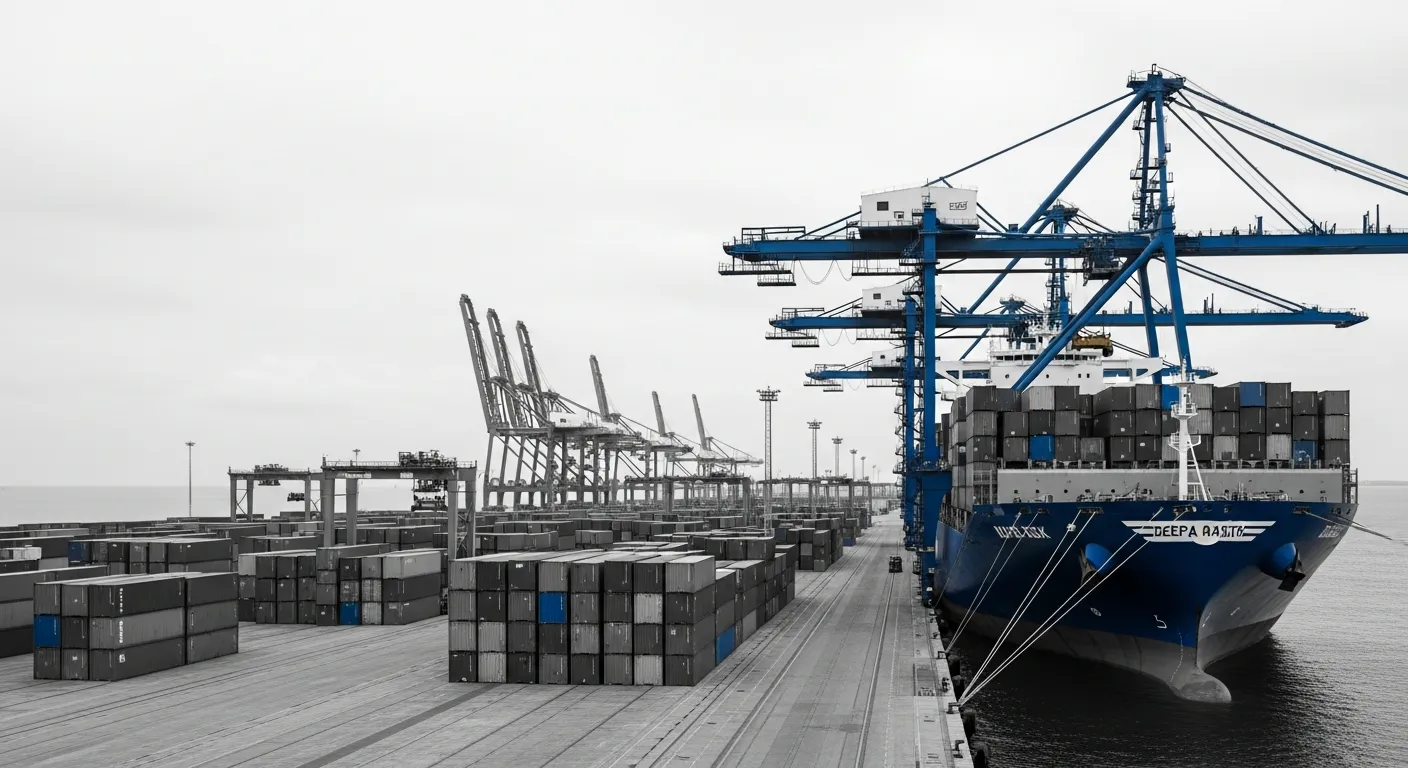
In May 2026, AD Ports awarded contracts totalling AED 735 million to execute the New East Mole's marine and landside infrastructure and procure container-handling equipment. Two contracts valued at AED 551 million went to MAR CONTRACTING SARLU and MBTP SA JV for marine and topside works, including quay construction and site preparation. Shanghai Zhenhua Heavy Industries Co. Ltd. secured a separate AED 184 million contract for the supply and delivery of three ship-to-shore cranes and nine rubber-tyred gantry cranes. The first phase will comprise a 420-metre quay wall with a depth of 16 metres, specifically engineered to handle Patagonia-class container vessels—among the largest in current service. Combined with Phase 1's originally budgeted USD 220 million investment for a 400-metre quay at 16-metre depth plus a 10-hectare logistics area, the expanded scope signals operator confidence in near-term demand and the terminal's capacity to serve as a sub-regional consolidation point.
The equipment specification reflects modern container-handling best practice. Three Super Post-Panamax ship-to-shore cranes will enable simultaneous loading and discharge of large-capacity vessels, whilst nine hybrid rubber-tyred gantry cranes provide yard-side mobility and flexibility. According to project information, the hybrid RTGs offer environmental benefits, reducing diesel consumption by up to 60% and saving approximately 1 million litres of diesel annually, equivalent to cutting roughly 5,000 tonnes of CO₂ emissions. This sustainability alignment meets both CMA CGM Group's decarbonisation agenda and the Republic of Congo's energy-efficiency objectives, crucial considerations for long-term port credibility in African markets increasingly scrutinised for environmental stewardship.
Deep-Water Advantage and Regional Transhipment Opportunity
Pointe-Noire is the Republic of Congo's second-largest city and home to the nation's busiest port. Critically, it is the subregion's only deep-water Atlantic port with direct access from the sea, a geographic distinction that eliminates the dredging, approach-channel, and tidal limitations that constrain competing West African gateways. The 16-metre depth and direct ocean access allow Pointe-Noire to accommodate ultra-large container vessels year-round without draft restrictions—a structural advantage when regional alternatives such as Conakry (Guinea) report average vessel waiting times around 11 days and multiple berthing delays, or Lagos (Nigeria) where port congestion and road-haulage constraints cause container backlogs and knock-on hinterland disruptions.
CMA CGM and AD Ports position the New East Mole as an Atlantic hub for transhipment and regional consolidation. The terminal will operate as a multi-user facility, meaning independent operators, freight forwarders, and regional shipping lines can book capacity alongside scheduled CMA CGM services, avoiding the single-operator lock-in that characterises some African terminals. Early projections suggest annual throughput of 1.3 million TEU once operational, with capacity to reach 2.3 million TEU in subsequent expansion phases. This dual-phase architecture allows both partners to scale operations in response to shipping-line commitments and regional import-export growth without overcommitting capital upfront. The facility's design to accommodate Patagonia-class vessels (up to 20,000+ TEU) positions Pointe-Noire to capture mainline East-West trade flows that might otherwise call Lagos, Abidjan, or Douala, where terminal constraints and hinterland congestion create schedule unreliability.
Supply-Chain Relief and Central African Procurement Gateway
West Africa's container trade has grown nearly 50% over the past decade, outpacing global averages, yet infrastructure has lagged demand. Multiple carriers, including Maersk, have applied congestion surcharges to shipments into West African ports such as Freetown, Conakry, and Monrovia. In 2026, regional waiting times remain elevated: Conakry averages 11 days, Abidjan 5.67 days, Tema (Ghana) 4.5 days. Inland cargo evacuation, road networks, and yard utilisation all contribute to systemic slowness. By positioning Pointe-Noire as a deep-water alternative with modern handling equipment, the New East Mole offers shippers and freight-forwarders a direct route into Central Africa (Democratic Republic of Congo, Central African Republic, Chad) that bypasses West African bottlenecks altogether.
For ship suppliers, chandlers, and procurement managers serving Central and West African operations, this new gateway reshapes sourcing strategy. Vessel operators planning calls in the interior Congo basin or supporting mining, oil, and LNG export activity in the region can now anchor provision cycles at Pointe-Noire instead of relying on secondary transhipment from Lagos or Abidjan, reducing dwell time and cost. AD Ports Group, which operates integrated trade, transport, and logistics services across its port portfolio, is developing a 10-hectare logistics zone adjacent to the terminal. This zone will house warehousing, freight-consolidation facilities, and potentially regional supply hubs where ship-supply companies can pre-position inventory (provisions, lubricants, spare parts, consumables) for rapid vessel provisioning on berth. Early adopters of this hub model—such as chandlery networks already established in AD Ports' Khalifa Port operations—will gain competitive advantage by reducing provisioning lead times for vessels operating Central African trade lanes.
Sustainability Integration and Environmental Credentials
Both AD Ports and CMA CGM have publicly committed to port decarbonisation and sustainable maritime infrastructure. At Khalifa Port, CMA Terminals' newly inaugurated facility includes shore-power provision for vessels to limit emissions, widespread solar-panel installations, and the region's first net-zero-carbon administration building powered by renewable energy. At Pointe-Noire, the hybrid RTG specification (60% diesel reduction, 5,000 tonnes CO₂ savings annually) reflects similar ambition. The Republic of Congo, as a signatory to IMO 2030 and 2050 decarbonisation targets and an MARPOL Protocol State, benefits from infrastructure that supports cleaner vessel operations and reduced port carbon footprint—assets increasingly central to attracting premium shipping-line calls and sustaining regional trade-finance investment.
The project's environmental profile also supports attracting institutional finance and development-bank participation. In parallel, Congo Terminal (a separate AGL-operated facility at Pointe-Noire focused on break-bulk and ro-ro cargo) secured €230 million in financing in March 2025 from Crédit du Congo, Attijariwafa Bank, and a consortium of regional banks to fund its own 750-metre quay expansion by 2027. The confidence of both international and Congolese lenders in Pointe-Noire's infrastructure modernisation underscores the port's strategic importance to Central African trade and the credibility of sustainability-aligned operations in this emerging market.
What This Means for Procurement and Supply-Chain Professionals
The commissioning of the New East Mole in H1 2027 creates immediate opportunities and challenges for maritime suppliers and logistics operators. Ship-supply companies should begin now to establish relationships with AD Ports Group and explore participation in the 10-hectare logistics zone, either through direct inventory positioning or joint-venture arrangements with regional distributors. Vessel-management companies operating Central African trade lanes should map alternative routing scenarios that leverage Pointe-Noire's deep-water advantage and reduced congestion versus established West African ports, capitalising on schedule reliability and lower demurrage risk. Freight forwarders and transport operators should monitor commissioning timelines closely: H1 2027 signals operational readiness by mid-year, but phased equipment delivery and initial-throughput ramp may extend full capacity availability into Q4 2027 or Q1 2028. Early-mover engagement with terminal marketing and CMA CGM's regional shipping schedule will be essential to secure preferred vessel-call slots and build long-term cost competitiveness. For regional procurement managers, Pointe-Noire's emergence as a multiuser hub reduces dependency on congested West African nodes and introduces a strategically placed, deepwater alternative designed to lower total supply-chain cost and improve predictability across Central and West African hinterlands.


