
"These continued attacks on shipping only serve to escalate tensions and threaten global supply chains on which everyone depends," the International Maritime Organisation secretary general stated following the Tihamah incident.
The Tihamah Attack: Escalation and Asymmetry
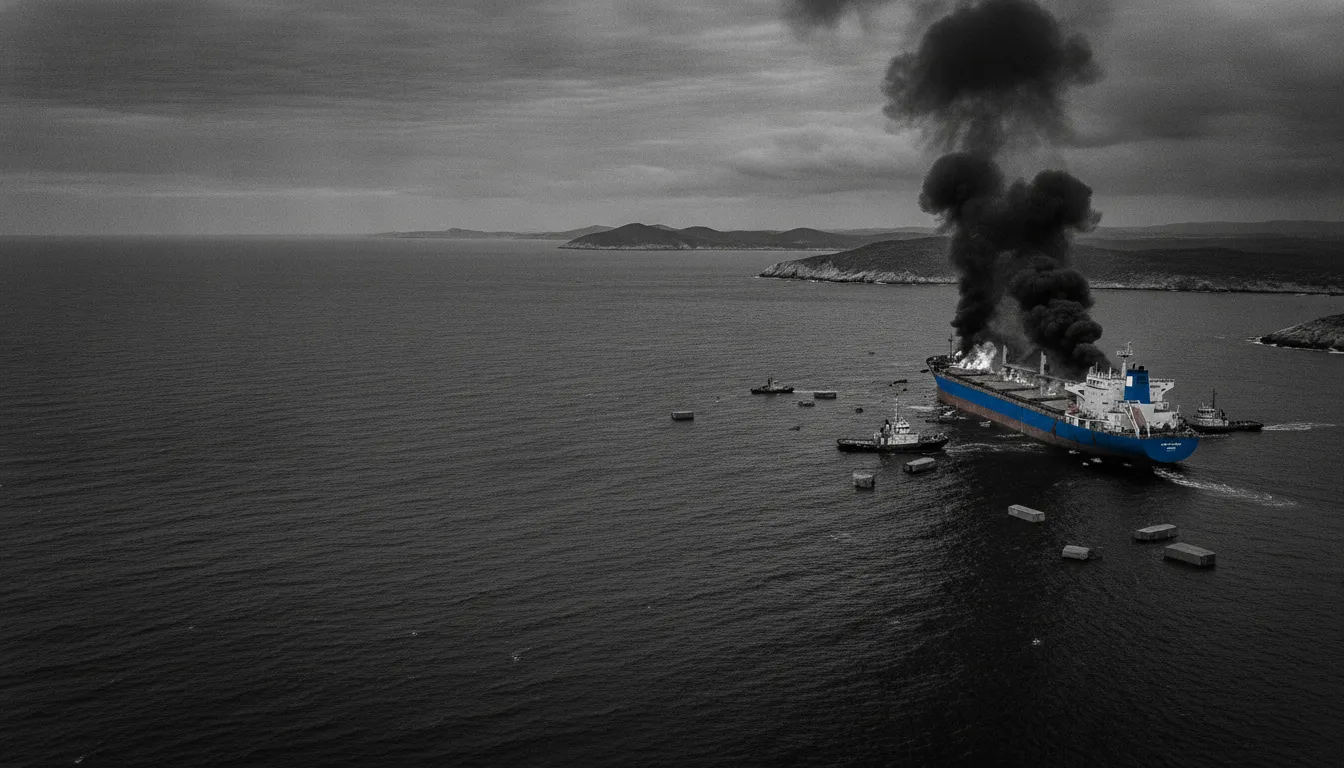
On 11 August 2026, the Tanzanian-flagged, Egyptian-owned multipurpose vessel Tihamah was struck by three ballistic missiles whilst transiting the Bab al-Mandeb Strait. The initial salvo killed four crew members—three Pakistani nationals and one Indonesian—and set the vessel ablaze. A second missile was fired at the ship during a rescue operation, killing two Yemeni coast guard rescuers. The double-tap pattern—targeting the vessel again as rescue teams engaged—signals a deliberate, planned tactical shift aimed at maximising human and economic cost rather than merely disrupting shipping traffic.
The Houthis claimed the Tihamah carried Saudi military equipment; the Yemeni government stated the vessel transported commercial goods and food supplies bound for Mokha port. What is indisputable: the fatalities aboard Tihamah mark the first deaths in a Houthi strike on shipping since the Iran war began on 28 February 2026. This threshold breach resets underwriting and geopolitical risk perception across maritime insurance markets and forces immediate reassessment of route economics that had begun to stabilise earlier in 2026. The UN Secretary-General expressed deep alarm about the resumption of Houthi attacks and the renewed threats to maritime navigation, signalling that international pressure and coalition operations (Operation Prosperity Guardian) have proven insufficient to deter the Iran-backed group's capability or resolve.
Freight Rates and Bunker Cost Architecture
The Cape of Good Hope reroute, mandated by sustained Red Sea insecurity since late 2023, adds 3,500–3,600 nautical miles and 10–14 days to Asia–Europe voyages. This distance penalty translates directly into bunker consumption: large containerships burning approximately 30 percent more fuel per voyage, incurring USD 400,000 to 800,000 in additional bunker cost on a single roundtrip. For reference, a 20,000-plus-TEU vessel absorbs between USD 400,000 and 800,000 in incremental bunker costs on a single voyage when forced around the Cape. For tanker operators, the tonne-mile penalty is even steeper: a Suezmax vessel diverted from its original Red Sea eastbound track to a westbound Mediterranean reroute will consume approximately 1,500 tonnes of additional heavy fuel oil, costing circa USD 800,000 with emissions implications of 3,800 tonnes of CO2.
Freight All Kinds (FAK) rates have absorbed this externality at a 25–30 percent premium over Suez-routed services. The per-TEU differential now ranges from USD 200 to 400 per unit of cargo once fuel, crew costs, and vessel positioning are counted. This premium reflects not merely the fuel uplift but also the capacity squeeze: with approximately 5–7 percent of the global container fleet now tied up on the longer Cape route (equivalent to 1.3–1.8 million TEU removed from circulation), the reduced effective fleet capacity has rippled across non-Red Sea lanes, driving rate inflation even on routes that do not touch the Red Sea. Escalation in crude oil prices—Brent crude hit USD 100 per barrel on 23 July 2026 following Houthi strikes on Saudi oil tankers Encelia and Layla—feeds directly into bunker fuel prices within days through Bunker Adjustment Factor (BAF) revisions. Any further geopolitical tension in the Strait of Hormuz, which carries approximately 20 percent of global energy supply and currently passes only around 7 ships per day (versus a pre-war average of 140 daily transits), will amplify this cost cascade exponentially. Carriers now face a fundamental choice: absorb the premium, pass it to shippers through rate surcharges, or accept lower vessel utilisation and slower service speeds to dampen voyage fuel burn.
Bunker Supply Fragmentation and Port-of-Call Restructuring
The simultaneous closure of the Strait of Hormuz by Iran (following US and Israeli strikes from March 2026 onward) and the renewed Houthi blockade of the Red Sea have demolished the assumption that fuel can be sourced at scale from traditional Gulf hubs. Vessel traffic through Bab al-Mandeb has collapsed from 50 ships per day to 32 per day since the Houthis' announced maritime embargo on 20 July 2026—a reduction of 36 percent in a matter of weeks. This fragmentation has begun to reshape the global bunkering map: procurement teams are now nominating alternative supply points—Port Said (Egypt), Malta, Gibraltar, Algeciras (Spain), Las Palmas (Canary Islands), Algoa Bay (South Africa) and Port Louis (Mauritius)—as intermediate fuel stops or ship-to-ship (STS) transfer points. These ports were not designed to absorb the unprecedented surge in tonne-mile demand now being displaced from traditional Red Sea and Gulf supply nodes.
Supply tightness at these alternate ports is emerging rapidly: purchasing teams report extended lead times for compliant very low-sulphur fuel oil (VLSFO) and marine gas oil (MGO), with local suppliers commanding premiums of 0.5–2.0 percent over published bunker indices. The convergence of unprecedented tonne-mile demand and stringent Mediterranean emissions regulations (EU ETS obligations scaling to 100 percent of intra-EU emissions) has created what bunker industry analysts term a "perfect storm." Fuel availability at Port Said has tightened; spot rates have climbed and early nominations (typically 24–48 hours in advance) are now required to secure adequate volumes. Ship-to-ship transfer operations have surged at secondary ports such as Sohar (Oman), Dammam (Saudi Arabia), Colombo (Sri Lanka) and along the South African coastline. Operators accustomed to ad-hoc, just-in-time bunker procurement now face the necessity of planning two voyages ahead and locking in fuel positions at higher cost and volume risk, effectively forcing bunker procurement from a working capital burden into a hedging decision.
War Risk, Insurance and Hedging Frameworks
War-risk insurance premiums on Red Sea transits remain elevated at 0.5–1.0 percent of hull and machinery value, compared to a baseline of approximately 0.0001 percent in the pre-crisis era. For a modern ultra-large containership with hull value of USD 150–200 million, this translates to USD 750,000 to 2.0 million per single Red Sea transit—a material line item that compounds with every voyage. The Tihamah fatality resets the underwriting conversation entirely: insurers will remodel loss-probability assumptions, likely tightening cover terms or imposing new conditions (convoy systems, armed security, alternative routing mandates) on vessels entering the Bab al-Mandeb. This will drive policy costs higher, extend underwriting timelines from days to weeks, and add operational friction for spot traders and short-haul operators who lack the corporate overhead to manage complex insurance negotiations.
Shipowners and operators now face a tripartite decision matrix: take the Red Sea route at elevated insurance cost and heightened operational risk; divert around the Cape and absorb higher fuel and time penalties; or stage fuel at intermediate ports to reduce exposure to any single supply node. Procurement teams must now evaluate three separate variables when sourcing bunker—commodity price (spot, BAF-adjusted, or forward-hedged), supplier geographic stability (willingness to deliver amid heightened geopolitical risk), and the insurance cost of the chosen routing—and integrate these into voyage accounting before departure. A hedge strategy that locked in crude prices or bunker swaps in April 2026 may now be obsolete by August, requiring rapid rebalancing of forwards, options and physical inventory positions. Financial teams accustomed to relatively stable bunker-cost modeling must now integrate real-time risk dashboards that incorporate geopolitical event data, insurance underwriting changes, and alternative route cost calculations.
Regulatory Compliance and Emissions Cost
The August escalation coincides with tightening maritime emissions regulations in the Mediterranean and Indian Ocean approaches. Operators routing around the Cape now navigate dual-compliance frameworks: International Maritime Organisation 2030/2050 decarbonisation targets; European Union Emissions Trading System (ETS) obligations for ships over 5,000 GT (effective 2024, scaling to 100 percent of intra-EU emissions and 50 percent of EU-external voyages by 2026); and individual port state control and flag state requirements. The EU ETS, in particular, creates a perverse incentive: vessels forced to burn more fuel to transit longer routes generate higher emissions and incur higher allowance costs, effectively penalizing operators for geopolitical disruption beyond their control.
A vessel burning an additional 1,500 tonnes of heavy fuel oil on a rerouted voyage generates approximately 3,800 tonnes of CO2. Under the EU ETS, that vessel incurs allowance costs scaling with carbon prices; current EU ETS allowance futures trade in the €80–95 range per tonne, meaning that additional CO2 emission will cost between EUR 304,000 and 361,000 (USD 335,000–397,000 at current exchange rates) in compliance costs alone. Compliance-bunker procurement—sourcing biofuels or lower-carbon fuels at premium to conventional VLSFO—has become a hedging instrument for emissions risk, but supply of sustainable marine fuels (SMF) remains severely constrained at 5–15 percent availability across major supply ports. Operators unable to secure compliant volumes must either pre-purchase allowances months in advance or accept compliance violations and associated penalties, effectively adding 2–5 percent to voyage operating costs for long-haul Cape routes. Some operators have begun exploring multi-sourcing and in-region supplier strategies to diversify bunker procurement and reduce reliance on any single geographic hub or fuel specification.
Procurement Team Action List: Immediate and Mid-Term Responses
Ship operators and buyers must execute rapid tactical and strategic adaptations across four horizons. Immediate actions—executable within 24–72 hours—include: revalidate war-risk insurance policies for current coverage terms, exclusions and premium levels; reboot voyage planning algorithms to model three simultaneous route options (Suez with premium insurance, Cape of Good Hope, Cape-plus-intermediate staging) with attached fuel costs, transit time burden, and emissions compliance cost; engage bunker suppliers at 5–10 designated alternate ports (Port Said, Gibraltar, Algeciras, Algoa Bay, Port Louis, Singapore, Rotterdam, Santos) and lock in daily forward price indications for 30–60 day lead periods; stress-test emergency fuel inventory levels at key regional hubs (Singapore, Rotterdam, Santos, Cape Town) against a two-week supply disruption scenario.
Mid-term responses—implementable within 30–90 days—should encompass: diversify fuel-sourcing contracts across at least three geographic regions and two fuel specifications (VLSFO and MGO) to avoid concentration risk at any single port or supplier; establish standing ship-to-ship transfer protocols with vetted, insurance-compliant suppliers at Gibraltar, Algoa Bay and Port Louis to enable flexible fuelling without forcing schedule delays; negotiate multi-year, price-collar agreements with physical bunker suppliers to cap both upside (USD 650–750 per tonne ceiling on VLSFO) and downside exposure and lock in volume commitments; and integrate emissions allowance procurement into fuel sourcing decisions, treating carbon as an explicit line-item cost rather than a post-voyage compliance surprise. For procurement teams managing procurement across multiple vessels, the priority is to centralise fuel negotiations at corporate level—not vessel-by-vessel—to capture volume discounts and geographic diversification leverage. A carrier with 20+ vessels can negotiate better terms and secure better access to scarce supply than individual master-operator arrangements.
The August 2026 Tihamah attack has shattered the illusion of a returning-to-normal Red Sea. With Houthi operational tempo and lethality now escalated, and with both the Red Sea and Strait of Hormuz effectively functioning as high-risk corridors, bunker sourcing has devolved into real-time geopolitical and meteorological forecasting, not commodity procurement. The simplicity of the Suez-routed bunker supply chain of 2022 is not returning within any near planning horizon. Operators who build redundancy, front-load fuel procurement, and maintain diversified supplier relationships will absorb these shocks with margin preservation. Those who procrastinate or rely on spot procurement will face rapid margin compression, schedule delays and unplanned emergency bunker purchases at distressed prices in isolated supply ports.
What This Means for You
Buyers and ship operators must treat Red Sea volatility as structural, not cyclical, and build bunker procurement into voyage risk management, not reactive commodity sourcing. Centralise fuel negotiations at corporate level rather than vessel-by-vessel basis to capture volume discounts and geographic diversification leverage. Engage P&L leadership and financial planning teams now to model a sustained 25–30 percent freight-rate premium and 15–20 percent bunker-cost uplift as baseline assumptions for 2026–2027, not transient hedges. Model the scenario of sustained dual-chokepoint disruption (both Red Sea and Hormuz) lasting 12–24 months, and build inventory and sourcing buffers accordingly. For procurement teams managing bunker contracts and voyage budgets, the Tihamah casualty signals that insurance and logistics models built on pre-2023 assumptions are obsolete: reset your planning horizon immediately, lock in supplier relationships before regional supply hubs saturate further, and treat emergency-stage fuel reserves at South African and East African ports as a non-negotiable operational cost of conducting business in a fractured, geopolitically fragmented Red Sea environment.