
"This partnership marks a shared commitment to revitalising South Africa's maritime infrastructure and unlocking new opportunities for growth for South Africa and the entire region." — Hans-Ole Madsen, ICTSI Senior Vice President.
Pier 2: A Critical National Asset Under New Management
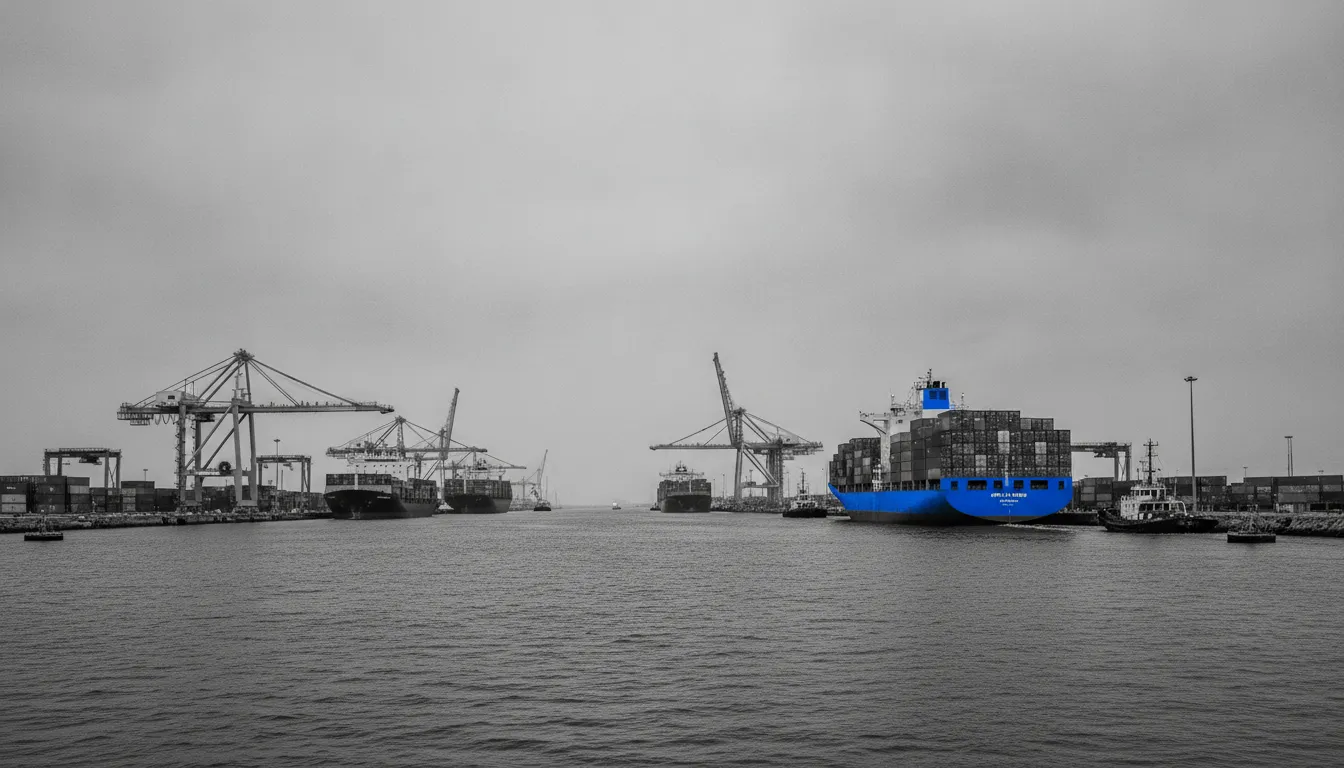
DCT Pier 2 is South Africa's most important container gateway. The terminal handles 72 per cent of Port of Durban's throughput and 46 per cent of the country's total container traffic. Prior to the ICTSI takeover, the facility operated under state-run Transnet management, a regime marked by documented underperformance. In a 2021 World Bank index of container port performance, Durban ranked 364th out of 370 ports globally. Chronic congestion, equipment failures, and labour disruptions have cost exporters and importers billions in hidden logistics charges and delays. The formal management transition on 1 January 2026 signals the beginning of what may be the most consequential infrastructure overhaul in South African maritime history.
The concession agreement, signed on 10 December 2025 after a legal battle lasting eighteen months, establishes Newco, a special-purpose vehicle in which Transnet Port Terminals holds 51 per cent and ICTSI holds 49 per cent. Although Transnet retains majority ownership, ICTSI assumes full operational responsibility and will deploy approximately $650 million (R11 billion) in capital investment. ICTSI was selected as preferred bidder in July 2023 after a rigorous tender process and faced a court challenge from Maersk's APM Terminals on solvency grounds; the Durban High Court dismissed APM's review in October 2025. ICTSI, the world's largest independent terminal operator, operates terminals across the globe and has pledged to bring global expertise and integrated terminal systems to modernise Durban's operations.
The Productivity Step-Change: What Numbers Mean in Practice
ICTSI's mandated performance targets are quantified and ambitious. Gross crane moves per hour will improve from 18 to 28—a 56 per cent lift in raw crane productivity. Ship working hours will extend from 60 to 120 hours, doubling the operational window for vessel turnaround. Annual throughput capacity will increase by 800,000 TEU (from 2.0 million to 2.8 million). These gains rest on new equipment (ship-to-shore cranes, straddle carriers, and integrated terminal systems), advanced automation, and process discipline. For major container lines and export-dependent shippers, faster vessel turns translate directly to reduced demurrage, lower port charges, and improved schedule reliability. Transnet and ICTSI project that these improvements will also reduce logistics costs and improve service quality, thus broadening market access to new shipments and competing more effectively against Cape Town and other regional terminals.
The broader context matters. The Strait of Hormuz closure has redirected global shipping around the Cape of Good Hope, turning South African ports into strategic waypoints for Asia-Europe and Asia-Americas trade. Faster container handling at Durban positions the port to capture rerouted traffic and bunker demand that would otherwise bypass the region. However, speed and efficiency in container operations can create friction points in ancillary services—ship supply, bunkering, and stevedoring arrangements—where access, pricing, and vendor selection are dictated by terminal operators.
The Supplier Access Question: Streamlined Operations vs. Third-Party Constraint
Industry observers and procurement professionals flagged concerns around vendor access as soon as the ICTSI award became public in 2023. When private terminal operators assume control, operating procedures often become more restrictive and technology-driven. Supply vendors, chandlers, bunker brokers, and specialist service providers must navigate new gate protocols, documentation systems, and preferred-supplier arrangements. The Southern African Association of Freight Forwarders (SAAFF) welcomed the public-private partnership as "potentially transformative" but stressed there is "no margin for error" and urged "robust oversight, transparency and accountability to ensure the concession benefits the national logistics system." SAAFF flagged the transaction structure and terms requiring "disciplined attention"—a tacit acknowledgement that the mechanism itself could inadvertently exclude smaller operators or lock in vendor dependencies.
Durban's bunkering sector is particularly exposed. The port is a major bunker hub for Indian Ocean shipping, with two oil majors supplying HSFO, VLSFO, and LSMGO grades. However, South Africa's remaining oil refineries have shut down; all bunker fuel is now imported. Under ICTSI operational control, bunkering barges, supply vessels, and bunker brokers face potential restrictions on vessel approach windows, berth allocation priority, and procedural requirements. Ship-supply chandlers managing inventory in warehouses and bonded stores near the terminal may encounter higher security costs, revised access schedules, or integration pressures favoring large, branded suppliers already integrated with ICTSI's global network. Smaller regional suppliers—particularly those based in South Africa and dependent on Durban throughput—risk losing market share to multinational service providers with existing ICTSI relationships in other ports.
Investment Mandates and Performance Accountability: The Legal Guardrails
The concession agreement does impose accountability. ICTSI must achieve defined crane productivity, capacity, and ship working hour targets or face financial penalties or performance review. The 25-year term means ICTSI has long-term incentive to maintain reputation and service levels; terminal operators across their global footprint depend on shipper feedback and carrier satisfaction. However, the agreement does not explicitly mandate third-party vendor access provisions, competitive procurement processes for ship-supply services, or transparency in bunker and stevedoring pricing. Industry precedent at ICTSI terminals in the Philippines and elsewhere suggests the operator favours consolidated, integrated service chains with preferred vendors and global logistics partners. This model reduces terminal complexity and maximises operational efficiency—but it can also create de facto monopoly conditions for smaller suppliers locked out by gate protocols or preferred-supplier exclusivity clauses.
Transnet's role as 51 per cent shareholder theoretically provides a governance check. However, Transnet itself has faced criticism for labour disputes and political interference, and its board has not publicly committed to protecting open access for independent ship suppliers. The concession agreement includes Transnet's obligation to support ICTSI's investment mandate, creating an alignment of interests that may subordinate broader supplier ecosystem concerns to terminal efficiency and shareholder returns.
Regional Supply-Chain Implications: The Southern Africa Trade-Off
Southern Africa's landlocked hinterland—Lesotho, Botswana, Zimbabwe, Eswatini, and Mozambique—depends heavily on Durban for import and export logistics. Faster container throughput will benefit these markets by reducing dwell times and transport costs. However, if ICTSI's operational model privileges multinational logistics firms and excludes local suppliers, the supply-chain benefit will be geographically uneven. Smaller regional ship-supply companies, bunker traders, and stevedoring contractors based in KwaZulu-Natal will face margin compression and reduced market access unless explicit protective measures are embedded in operational protocols or Transnet exercises active oversight. The agreement does not publicly commit to preferential procurement for South African suppliers or mandatory transparency in vendor selection. This omission is conspicuous in a state-owned partnership intended to serve national economic interests.
Durban's historical role as a South African maritime hub extends beyond containers. The port remains critical for break-bulk, breakbulk, general cargo, and the fast-growing short-sea shipping sector within Southern Africa. ICTSI's focus on container efficiency may inadvertently marginalise non-containerised traffic and smaller-scale suppliers who depend on older, slower terminal infrastructure. Port leadership has not publicly articulated how Pier 2's privatisation will integrate with or affect non-container operations at other Durban terminals.
What This Means for You: Proactive Positioning in a Redrawn Supply Ecosystem
Ship suppliers, bunker traders, and logistics operators in South Africa face a strategic inflection point. ICTSI's operational takeover will deliver genuine efficiency gains—faster vessel turnaround, lower demurrage risk, and improved reliability. These benefits will flow to customers. However, the access landscape will shift. Independent suppliers should anticipate stricter gate protocols, documentation requirements, and possible preferred-vendor arrangements. Suppliers not already integrated with ICTSI or other major private terminal operators globally should consider: engaging directly with ICTSI commercial teams now to clarify access terms and service agreements; diversifying customer bases to reduce exposure to single-terminal dependencies; and investing in digital compliance systems to meet ICTSI's procedural standards. Bunker traders and bunkering operations should confirm their position in any ICTSI-endorsed bunker scheduling or vessel-approach protocols. Regional suppliers should lobby Transnet for explicit transparency commitments and consider forming consortia to strengthen negotiating power with the new operator. The 1 January 2026 commencement date has passed; the period of operational transition and protocol bedding-in will determine whether supplier access becomes a genuine constraint or merely a process adjustment. Early engagement is essential.