
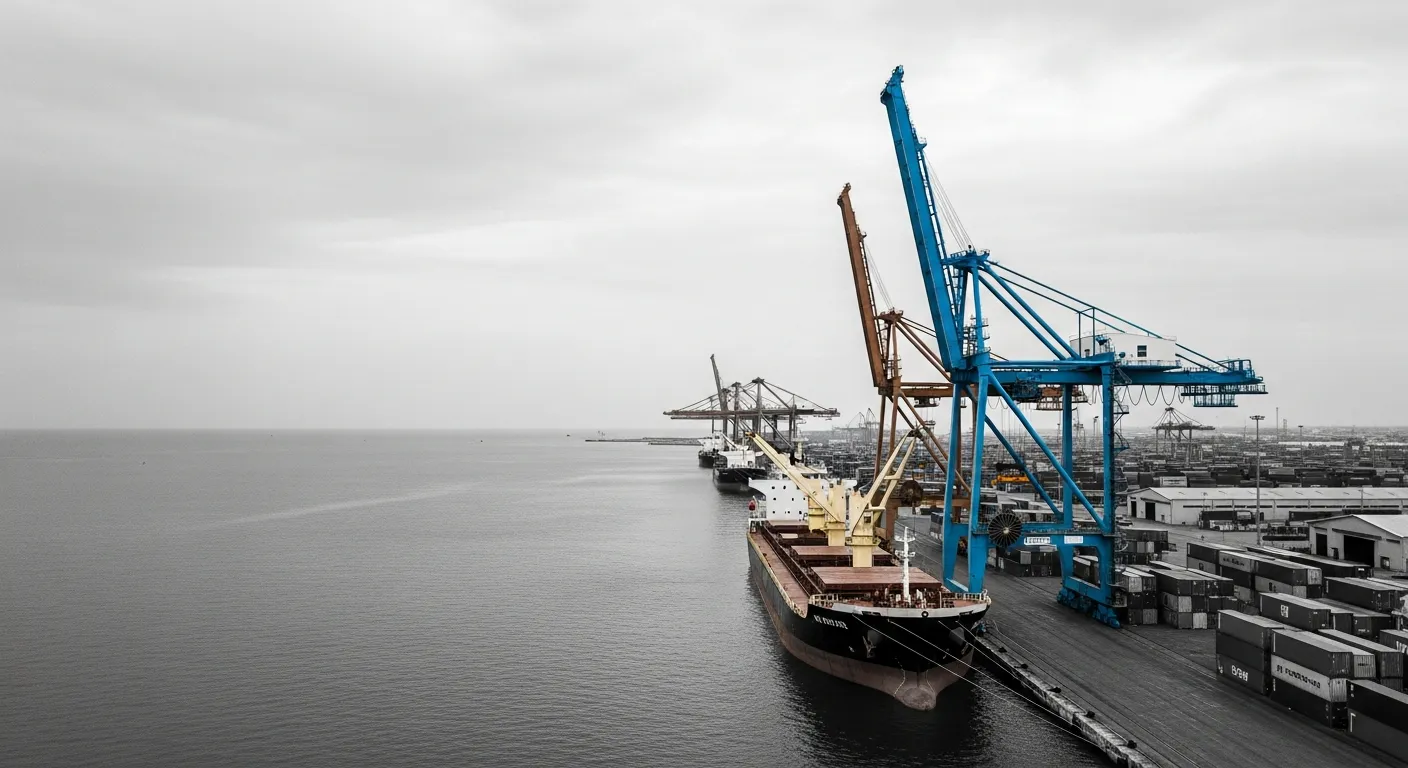
"The Douala dry bulk terminal will enhance trade resilience, support industrial development, and strengthen Cameroon's role as a gateway to Central Africa." – Mohamed Eidha Al Menhali, Regional CEO, AD Ports Group, February 2026
The Deal: A 30-Year Concession and $87 Million Phase One
On 12 February 2026, AD Ports Group—a UAE-based operator with established presence in Egypt, Morocco, Tunisia, Kenya, Tanzania, Angola and the Republic of Congo—formally joined Africa Ports Development's 30-year concession to design, build and operate the new terminal. The partnership structure allocates 60 per cent ownership to AD Ports and two other UAE investors, with Africa Ports Development retaining 40 per cent. AD Ports holds an effective economic interest of 51 per cent, positioning the Abu Dhabi-headquartered group as operational lead and the senior partner in day-to-day facility management and commercial strategy.
Phase one investment stands at approximately AED 320 million (US$87 million or EUR 73.4 million), covering two berths and approximately 450 metres of quay wall. The facility will handle four million tonnes of dry bulk annually—clinker, gypsum, fertiliser and grain—commodities critical to construction, agriculture and food security across Central Africa. Construction runs 2026 to 2028 in close coordination with the Port Authority of Douala. The broader concession framework, structured as a public–private partnership (PPP) under a 25-year Build-Operate-Transfer (BOT) model, represents total investment of approximately CFA 282 billion across all planned phases. This phased approach allows operators to test demand, scale infrastructure incrementally and capture market growth without overextending capital commitments.
Central Africa's Trade Bottleneck: Why Douala's Expansion Matters
Douala is Cameroon's economic capital and largest maritime port. It handles 80 per cent of the country's bulk cargo and 85 per cent of national trade volumes, serving also as the critical transit gateway for landlocked Central African states including Chad and the Central African Republic. Existing capacity constraints at Douala and competing regional hubs create acute demand for dedicated dry bulk berths capable of handling modern Panamax and handy-size bulk carriers without costly delays and congestion surcharges.
The new terminal directly addresses this structural gap. With strong hinterland connectivity to industrial centres and regional trade corridors spanning Central Africa, the facility will ease port congestion, improve vessel turnaround times and strengthen Douala's position as a key regional distribution hub. AD Ports stated the terminal will enhance efficiency of key cargo flows and strengthen regional supply chains, a critical outcome given the port's role as a consolidation point for goods destined for multiple landlocked markets. The project also aligns with the Port Authority's broader modernisation drive to specialise terminal infrastructure by commodity type and increase throughput efficiency. Prior to this expansion, Douala's general-purpose terminals created bottlenecks for time-sensitive grain and fertiliser shipments, particularly during seasonal import peaks.
Employment and Economic Impact: 4,000 Direct and Indirect Jobs
The terminal is expected to create up to 4,000 direct and indirect job opportunities during construction and long-term operations, supporting workforce development and skills transfer across Cameroon's maritime and logistics sectors. Employment will span construction trades, cargo handling, equipment operation, administrative roles and transport integration roles linking the port to hinterland distribution networks.
Beyond employment, the project reinforces Cameroon's role in the continental trade network and supports long-term economic growth in one of Central Africa's largest markets. Cameroon is the largest economy in Central Africa, with moderately expanding demand in sectors including mining, agriculture, infrastructure and energy. Major concurrent infrastructure projects—notably the Nachtigal hydroelectric plant and the expansion of the Kribi deep-sea port—are enhancing power supply and trade capacity, supporting industrial growth. The Douala dry bulk terminal enters this favourable environment, positioned to capture rising imports of construction materials (cement clinker), agricultural inputs (fertiliser and potash) and foodstuffs (grain) driving demand for dedicated bulk facilities across the region. These commodity flows are inelastic and structural; as Central African economies expand, demand for these bulk imports will compound, ensuring sustained terminal utilisation.
What This Means for Ship Suppliers and Chandlers
The 2026–28 construction timeline creates immediate procurement opportunity for maritime service providers. Ship suppliers, dry-dock service providers and chandlers should begin mapping partnerships with AD Ports, Africa Ports Development and local Douala port service providers immediately. Demand will include vessel provisioning contracts, maintenance supply chains, crew services, stevedoring partnerships and port logistics support during the build phase and operational ramp-up.
Chandlers operating across the Gulf of Guinea and Central Africa should position themselves to support the influx of bulk carriers calling the new terminal once operational. Routine ship supply lines—crew change facilitation, fresh provision delivery, lubricant supply, compliance documentation, waste management and spare parts logistics—will be essential to maintain vessel schedules and regulatory compliance. Suppliers with existing relationships at Douala Port or Cameroon's other maritime gateways (Limbe, Kribi) hold competitive advantage, particularly those with ISO 9001 certification, health and safety protocols compliant with IMO standards and proven delivery infrastructure. However, the terminal's activation will create sufficient incremental demand—estimated at four million tonnes annually—to support credible new market entrants with professional insurance, established supply chains and documented experience serving bulk vessel operations.
Regional Gateway and Feeder-Line Connectivity
The terminal's design incorporates strong hinterland connectivity, linking Douala to major industrial centres and regional trade corridors. This positions it as a consolidation and transshipment point for feeder services into landlocked Central African markets. Smaller regional ports, river terminals and inland distribution hubs will funnel containerised and break-bulk cargo to Douala; likewise, the new facility will enable faster transit of cargo from Central Africa back to international deep-sea lines serving Europe, Asia and the Americas. Vessel operators report that specialised bulk berths reduce average port dwell time by 40–60 per cent compared to general-purpose terminals.
For logistics providers and freight forwarders, this architecture creates demand for inter-modal coordination services, warehouse and staging facilities near the terminal, and documentation support for customs clearance across border regions. Suppliers offering integrated warehousing, labelling, consolidation and final-mile delivery solutions will find growing demand from importers and exporters using the facility as a regional distribution centre. Cameroon's National Development Strategy (2020–2030) emphasises industrialisation and import substitution, which will drive domestic demand for raw materials (grain, fertiliser) and construction inputs (clinker) funelled through the port.
Procurement Window: Now Is the Time to Act
The concession agreement was signed in February 2026. Ground-breaking occurred in July 2025 (announced by Prime Minister Joseph Dion Ngute) and equipment procurement will accelerate through late 2026 and 2027. Ship suppliers and maritime service providers who establish relationships with AD Ports and Africa Ports Development in the next 6–12 months will secure early-stage contracts for terminal support vessels, bunker supply logistics, provision warehousing, and crew services during construction. Likewise, those who secure supplier status with the Port Authority of Douala can position themselves for long-term vessel service contracts post-2028 operationalisation when throughput is expected to ramp rapidly.
For buyers—particularly importers of grain, fertiliser and construction materials into Central Africa—the terminal's commissioning in 2028 will offer direct cost savings through reduced port dwell time, improved vessel scheduling on dedicated bulk berths and competitive rate pressure from the new capacity. Bulk traders and commodity importers should monitor the project timeline and begin pre-positioning logistics partnerships and storage arrangements at or near Douala to capture these efficiencies and secure long-term supply agreements ahead of terminal activation.


