
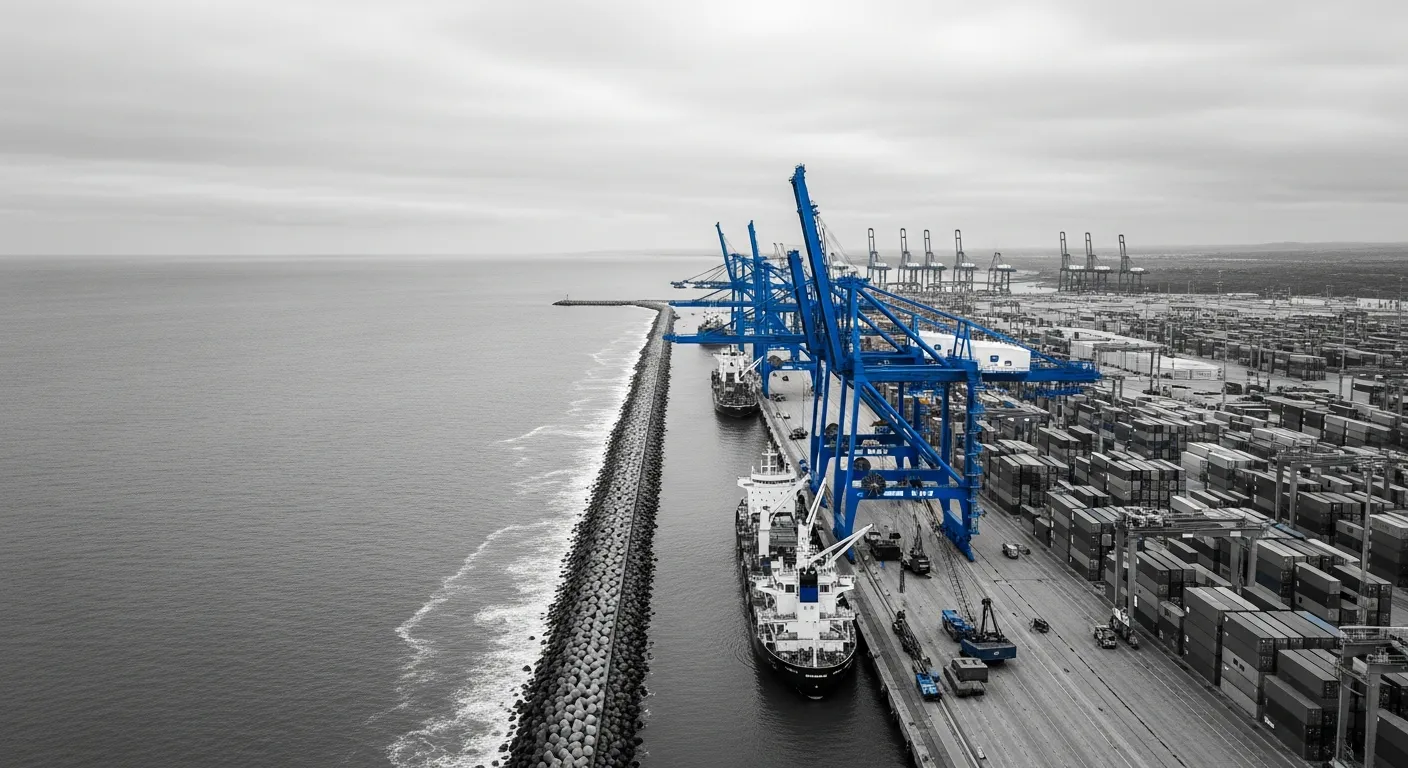
"This development will increase terminal capacity from 1 million to more than 2.3 million twenty-foot equivalent containers (TEUs) handled per year."
Scale of the Expansion: The €400 Million Commitment
Congo Terminal, a subsidiary of Africa Global Logistics (AGL) and a joint venture partner with APM Terminals and SOCOTRANS, announced in September 2024 that work on the Môle Est facility had already commenced. The total investment exceeds €400 million (approximately US$438 million), making it one of Central Africa's largest port infrastructure projects in recent years. In March 2025, the company secured €230 million (US$250 million) in financing through a syndicated bank round led by Crédit du Congo and Attijariwafa Bank, with participation from EcoBank, Banque Commerciale Internationale, Banque Sino-Congolaise pour l'Afrique, and BGFIBank Congo—all Congolese institutions. This financing structure is notable: it demonstrates that international lenders now view Central African port infrastructure as bankable, and that Congolese banks possess the capital depth to underwrite major trade-critical projects.
The project timeline is accelerating. In June 2025, Congo Terminal completed backfilling of the new port platform using approximately 1.2 million cubic metres of sand, half of which came from the sand trap located beside the breakwater, thereby minimising ongoing maintenance dredging. The pile-driving phase finished on schedule, and as of July 2026, the company reports on track for H1 2027 delivery. Construction of the 750-metre quay itself began following contract award to China Road and Bridge Corporation (CRBC), selected through international tender for its technical capability and existing local presence in Congo. The three-year construction phase reflects the complexity of marine civil works in Atlantic coastal conditions, including the major dredging campaign designed to widen the approach channel to 300 metres at the curve and 250 metres in remaining sections.
Terminal Specifications: Capacity for Ultra-Large Container Ships
The new Môle Est will feature 750 metres of quay wall with a minimum draught of 17 metres—deep enough to accommodate the largest container vessels currently serving Asian, Indian and European routes. The facility spans 26–28 hectares of quayside (sources vary slightly; 26 hectares cited by AGL, 28 hectares by others), providing ample stacking and staging capacity for transient cargo. At 17-metre depth and 750-metre length, the quay aligns with specifications for Patagonia-class vessels and future-generation ships, positioning Pointe-Noire to accept cargo directly from mother ships operated by CMA CGM, Maersk, and other major carriers without transhipment loss.
The craning specification reflects a commitment to efficiency and sustainability. The terminal will deploy 16 fully electric gantries comprising four Ship-to-Shore (STS) and twelve Rail-Mounted Gantry (RTG) cranes, or (per later specifications) five STS and fifteen electric RTGs (eRTGs), alongside 30 electric tractors. The facility also includes 1,680 reefer power sockets for refrigerated container handling—a critical feature for Central African agricultural, pharmaceutical and seafood exports destined for European and Asian markets. Total infrastructure will span approximately 4,000 square metres of administrative and operational buildings. All equipment meets EDGE certification requirements for environmental performance, positioning Pointe-Noire as a sustainable gateway in a region where operational standards often lag global benchmarks. The 100% electric craning specification distinguishes this terminal from competing regional facilities and aligns with IMO 2030/2050 decarbonisation targets.
Regional Capacity Impact: Doubling Container Throughput in High-Growth Market
Current Pointe-Noire container throughput stands at approximately 1 million TEUs annually (recorded at 1,046,064 TEUs in December 2024). The expanded terminal will push capacity to more than 2.3 million TEUs per year—a 130% increase that effectively doubles the port's role in regional trade and cements its position among Africa's emerging container gateways. This expansion arrives at a critical juncture: Central Africa accounts for only 3% of Africa's total container traffic but has experienced one of the highest volume growth rates since 2010, driven by oil and gas developments, agricultural expansion, and deepening regional trade integration. Key ports such as Douala (Cameroon), Pointe-Noire and Matadi (Democratic Republic of the Congo) are emerging as regional hubs. Douala, which handles approximately 5,000 TEUs annual capacity, will face direct competition from the enlarged Pointe-Noire facility, particularly for Angola-bound transshipment.
For procurement teams and traders, this capacity surge translates directly into reduced vessel rotation times, more frequent weekly services from Asia and Europe, and improved access to larger ships capable of carrying full shiploads and achieving per-container cost reductions of 15–20%. Historically, Angola, Congo and Cameroon suppliers have had to consolidate at secondary hubs (Lagos, Abidjan or even South African ports such as Durban) or endure extended sailing schedules. The East Mole will collapse those inefficiencies for goods destined to the Central African Customs and Economic Community (CEMAC) nations and Angola's oil-dependent economy. The 17-metre draught also eliminates tide-dependent scheduling constraints that plague shallower West African ports, enabling consistent 24/7 operations and predictable delivery windows—critical metrics for just-in-time supply chains.
Employment and Economic Spillover: 900+ Jobs and Infrastructure Connectivity
The Môle Est project is committed to creating over 900 new permanent positions once operational, in addition to construction employment during the 2024–2027 build phase. Congo Terminal currently employs more than 900 permanent staff and is designated a company of national importance by the Central African Banking Commission (CABC). The workforce expansion will support increased operational intensity—more cranes, more cargo handling, more customs and documentation services—but also reflects local investment in terminal management training and maritime logistics skills. Port Autonome de Pointe-Noire (PAPN) Managing Director Séraphin Bhalat stated that the project will boost economic exchanges throughout the sub-region and contribute to the country's economic and social development.
The broader ecosystem benefit extends beyond terminal gates. The project catalyses upgrades to port access roads, enhanced rail connections to inland markets, and dredging infrastructure improvements. These developments reduce last-mile logistics costs and improve connectivity for landlocked nations such as Zambia, Zimbabwe and the Democratic Republic of the Congo accessing the Atlantic via Pointe-Noire's corridor. Congo Terminal has committed to local content provisions: CRBC's selection prioritised its commitments to employ Congolese workers and source local materials where feasible. This approach differentiates modern African port investment from earlier concession models and strengthens political legitimacy for the project.
Competitive Positioning and Transshipment Strategy in Central Africa
The Môle Est expansion is explicitly designed to consolidate Pointe-Noire's role as a regional transshipment and consolidation hub. Angola's Luanda port, despite handling approximately 70–80% of non-petroleum trade (beverages, automobile components, coffee, cotton and oilseeds), remains primarily an import/export gateway rather than a regional consolidation point. By contrast, Pointe-Noire—with its new capacity and central Atlantic position—can capture transshipment flows from Angola, Gabon, Cameroon and the Democratic Republic of the Congo, reducing per-unit logistics costs for shippers and enabling suppliers to aggregate smaller shipments before final delivery to hinterland destinations.
This competitive advantage also stems from strategic timing and political backing. Though West African hubs such as Lomé (Togo) have established transshipment dominance at 3% of Africa's container volume, Central Africa lacks comparable deep-water facilities capable of handling modern megaships. The expansion aligns with President Denis Sassou-Nguesso's stated vision to make Pointe-Noire the reference transshipment hub for the entire sub-region—a goal that commands sustained political backing, regulatory continuity, and concession extensions. In August 2023, the government amended Congo Terminal's concession contract to extend the agreement until 2050 in exchange for the expansion commitment, signalling long-term stability and investor protection.
What This Means for Procurement Teams and Suppliers
For procurement officers sourcing components, raw materials or finished goods across Angola, Congo and Cameroon, the H1 2027 Môle Est opening reshapes three operational metrics: lead times will compress as vessel frequency increases from fortnightly to weekly service windows and port congestion eases; inventory holding costs will decline as goods move faster from berth to warehouse and customs clearance accelerates; and freight rate negotiation power will improve as larger ships reduce per-container maritime costs by 20–30%. Suppliers based in Europe and Asia will gain weekly (rather than bi-weekly or monthly) scheduling slots to Central Africa, enabling just-in-time procurement models previously impossible in the region. The terminal's €400 million investment, backed by local and regional financing, signals sustained capacity and operational reliability—critical factors when structuring multi-month supply contracts into a historically volatile logistics environment. By H1 2027, Pointe-Noire will no longer be a secondary port in the Central African supply chain; it will be the primary gateway.


