
"War risk premiums have since increased even further, reaching 1% of an insured vessel's value for a vessel transiting through" contested corridors, while a single voyage for a $100 million tanker now risks insurance costs jumping from roughly $200,000 to about $1 million.
Damietta Attack Signals Expanded Geographic Risk
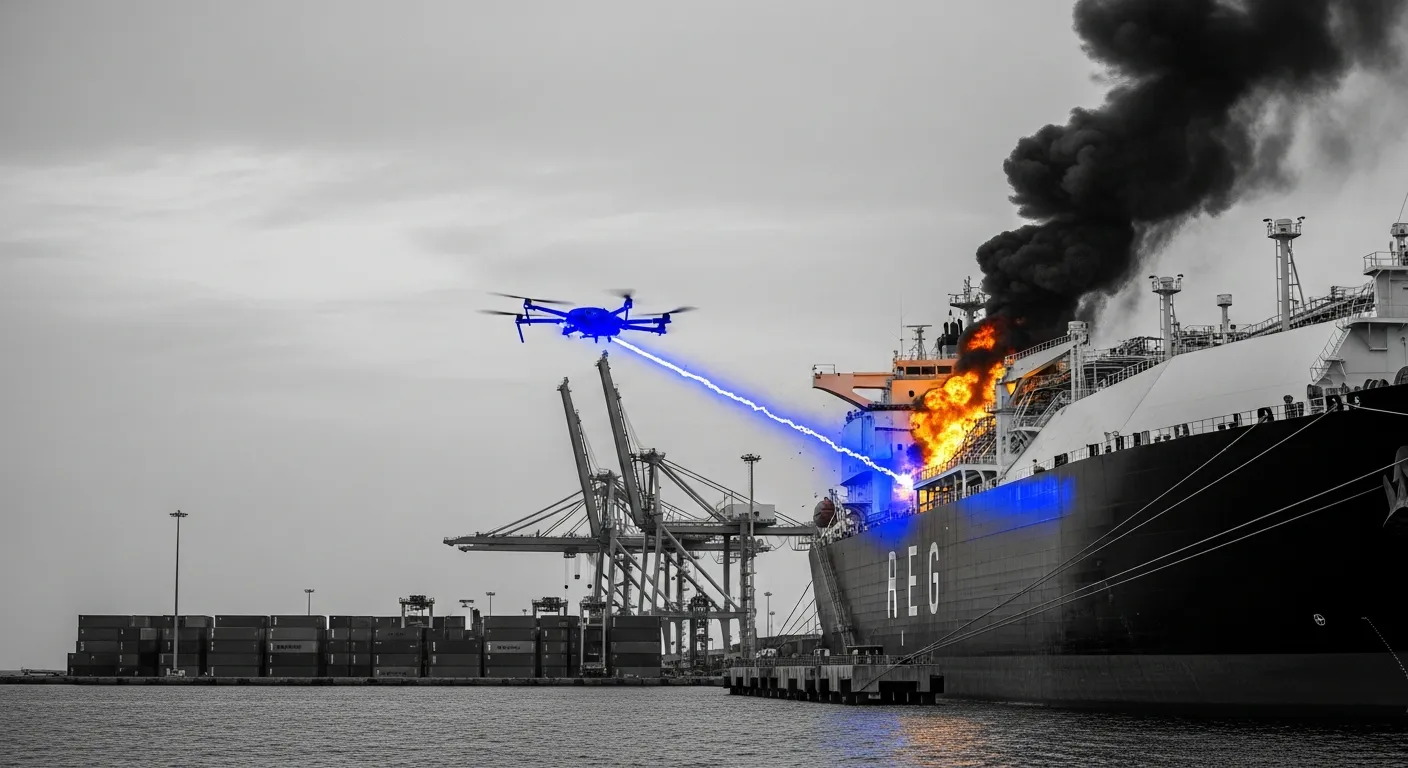
On 29 July, a drone struck the Energos Winter, a US-owned floating storage and regasification unit, at Damietta port in Egypt's Mediterranean Nile Delta. The impact triggered a fire that spread to the Gaslog Salem, a storage vessel. Egypt's cabinet confirmed the attack on 30 July, stating that "preliminary investigations by the relevant authorities found that the incident was caused by a drone." No party has claimed responsibility for the strike. Maritime security firm Ambrey documented the incident; energy analytics firm Kpler reported that "operations disrupted" at Damietta, one of Egypt's main LNG import terminals, and both vessels were moved offshore as authorities assessed damage. Damietta hosts a critical liquefied natural gas hub serving Egypt's Mediterranean coast and European energy markets.
The attack lies just hours' sail from the Suez Canal, the vital waterway linking Mediterranean and Red Sea commerce. Damietta serves as Egypt's principal gateway for liquefied natural gas regasification, with the facility operating at very high pressure. A former head of the Damietta Port Authority noted that "the regasification process occurs at very high pressure and that any leak could cause a fire," underscoring the cascading risk inherent in targeting energy infrastructure at scale. The strike marks the first attack on Egyptian soil since the US-Iran war began in February 2026, amplifying Egypt's exposure to a conflict it has sought to avoid. Egyptian President Abdel Fattah el-Sisi warned of "the danger of regional escalation" following the attack. Port authority statements confirmed operations resumed at other berths, yet the incident has already forced operators to recalculate exposure across two critical trade arteries simultaneously and to recognise that port-side infrastructure, not just open-ocean transits, now carries drone-strike risk.
Insurance Market Repricing Across Twin Chokepoints
The Damietta strike came days after Iran-aligned Houthis declared a maritime embargo against Saudi Arabia on 20 July, prompting London's Joint War Committee to widen its "high risk" zone in the Red Sea. The extended high-risk zone now takes in more of the Red Sea coast adjacent to Saudi Arabian ports and reaches close to the Saudi port of Jizan. The JWC adjusted "the Red Sea notification line northwards" after two Saudi-linked vessels were attacked in the first few days following the Houthi announcement. War-risk premiums for southern Red Sea voyages have jumped dramatically: from 0.3% of vessel value before the Houthi blockade announcement on 20 July to between 1% and 2% of vessel value as of late July—a six-fold increase in premium costs within days.
For a $100 million tanker, a single seven-day voyage now carries insurance costs climbing from roughly $200,000 to approximately $1 million. Insurers including Gard, Skuld, NorthStandard, the London P&I Club and the American Club have already cancelled or severely restricted war-risk cover for designated zones, leaving operators scrambling to find alternative underwriters or navigate uninsured. The repricing is described by insurance analysts as "permanent structural repricing"—no longer temporary hedges but a baseline reset reflecting the belief that maritime geopolitical risk has become structural rather than cyclical. With a dozen ships attacked in and around the Strait of Hormuz since 6 July alone, according to the International Maritime Organisation, and at least 38 vessels attacked since late February 2026, the insurance market is treating maritime conflict as a durable feature of operations, not an anomaly expected to resolve within months. The consequence is that insurance now functions as a defining barrier to economic viability of routes once treated as dependable arteries for global trade.
Bunker Supply Chains Face Routing Dilemmas and Cost Pressures
Operators have begun turning away from direct Red Sea transits, forcing a recalculation of fuel sourcing strategies. Lloyd's List Intelligence reported that transits through the Bab el-Mandeb for the week ending 19 July reached their highest level since December 2023, but "this trend is now at risk of reversing" following the Houthi embargo announcement and subsequent drone activity. Four Saudi-flagged tankers carrying 3.8 million barrels of crude, gasoil and naphtha turned around before reaching Bab el-Mandeb in late July. Tankers avoiding the southern Red Sea must now route via Suez or SUMED (Suez-Mediterranean pipeline), yet a fully laden VLCC cannot transit Suez—cargo must be partly offloaded at SUMED's Red Sea end and reloaded in the Mediterranean, adding time, fuel costs and additional handling risk. Routing around Africa via the Cape of Good Hope instead adds weeks to transit times and substantial fuel surcharges.
Saudi Arabia's Yanbu export terminal on the Red Sea has become the critical alternative to the Strait of Hormuz following its closure, yet Houthi blockade threats now imperil that workaround as well. The structural consequence, according to maritime analysts, is that the region is "designing around both Hormuz and Bab el-Mandeb to the maximum extent possible"—shifting toward overland corridors, bypass pipelines and forward storage near key markets, a multi-year architectural shift with heavy cost implications. Brent crude surpassed $100 per barrel for the first time since May, reflecting the structural pressure on global crude availability and transport costs. Buyers must diversify bunker sourcing immediately: relying on single Red Sea or Hormuz-dependent suppliers now carries uninsurable risk. Forward contracts and emergency supply agreements with Western Mediterranean and Atlantic basin suppliers are becoming operational necessities, not contingencies. Operators should also audit supply chain visibility for any dependence on fuel sourced through either chokepoint.
Coalition Response and Its Operational Limits
Saudi Arabia unveiled a 43-nation maritime defence coalition on 30 July, with the Saudi Ministry of Defence aiming to "enhance maritime security, protect international maritime corridors, and counter threats targeting maritime navigation and global trade." The coalition identified key corridors as the Bab Al Mandeb strait, Red Sea and Gulf of Aden; 14 nations issued a joint statement committing to "execution of joint maritime operations", training, intelligence sharing and joint exercises. Saudi Arabia would host coalition headquarters. The initiative represents the most comprehensive multilateral response to maritime conflict since the 2023 Operation Prosperity Guardian coalition activated for the Red Sea.
UK and France are simultaneously preparing a separate multinational naval escort operation in the Strait of Hormuz, led by Britain and France and coordinating with Oman, with Oman's Port of Duqm serving as the coalition's principal logistics hub. However, coalition responses face structural limits. Military escort capacity cannot match the volume of transiting commercial traffic—estimates suggest over 20,000 seafarers operate in the region daily—nor can surface vessels reliably intercept swarms of drones operating at standoff ranges. Coalition operations address the tactical manifestation of threat at sea, not the underlying geopolitical drivers of attack. Analysts emphasise that "a sustainable strategy must protect ships while addressing the behaviour and networks behind the attacks," combining "military defence with financial intelligence, customs cooperation, export controls, law enforcement, port security, cyber protection, capacity building, and diplomacy." Operators should not assume coalition presence eliminates insurance surcharges or restores pre-crisis risk pricing.
What This Means for Buyers and Operators
Immediate actions: Review war-risk insurance policies before renewal—cancellations are active and coverage gaps are widening. Audit your vessel's flag state, ownership structure, cargo type and any perceived linkage to US, UK or Israeli interests, as these increase interception risk and insurer caution. For energy cargoes, lock in bunker supply contracts outside Red Sea and Hormuz corridors now; contract terms that assume southern-route access are obsolete. Establish emergency diversion procedures to Cape of Good Hope and alternative Mediterranean sources; longer transits are expensive but insurable. Brief crew on GNSS spoofing and jamming hazards that persist across the operating area, and coordinate closely with naval coalition awareness calls and queries.
Structural implications: The Damietta strike confirms that maritime conflict has migrated from open-ocean transits into port infrastructure itself. No single coalition patrol can guarantee port-side safety or terminal operations continuity. Plan for a multi-year environment where war-risk insurance remains permanently elevated, chokepoint closure scenarios occur in pairs rather than isolation, and insurance underwriters price for sustained geopolitical instability rather than temporary disruption. The global maritime system is reshaping around both Hormuz and Bab el-Mandeb constraints, with overland corridors, bypass pipelines, and forward storage spreading capacity across the region. Roughly 80% of global merchandise trade by volume moves by sea; disruption to a single major route delays cargo, tightens supplies and drives up prices for energy, food and consumer goods thousands of miles away. Operators who diversify routing, bunker sourcing, insurance arrangements and port calls will navigate the transition; those betting on rapid normalization will face margin compression and operational surprise.


