
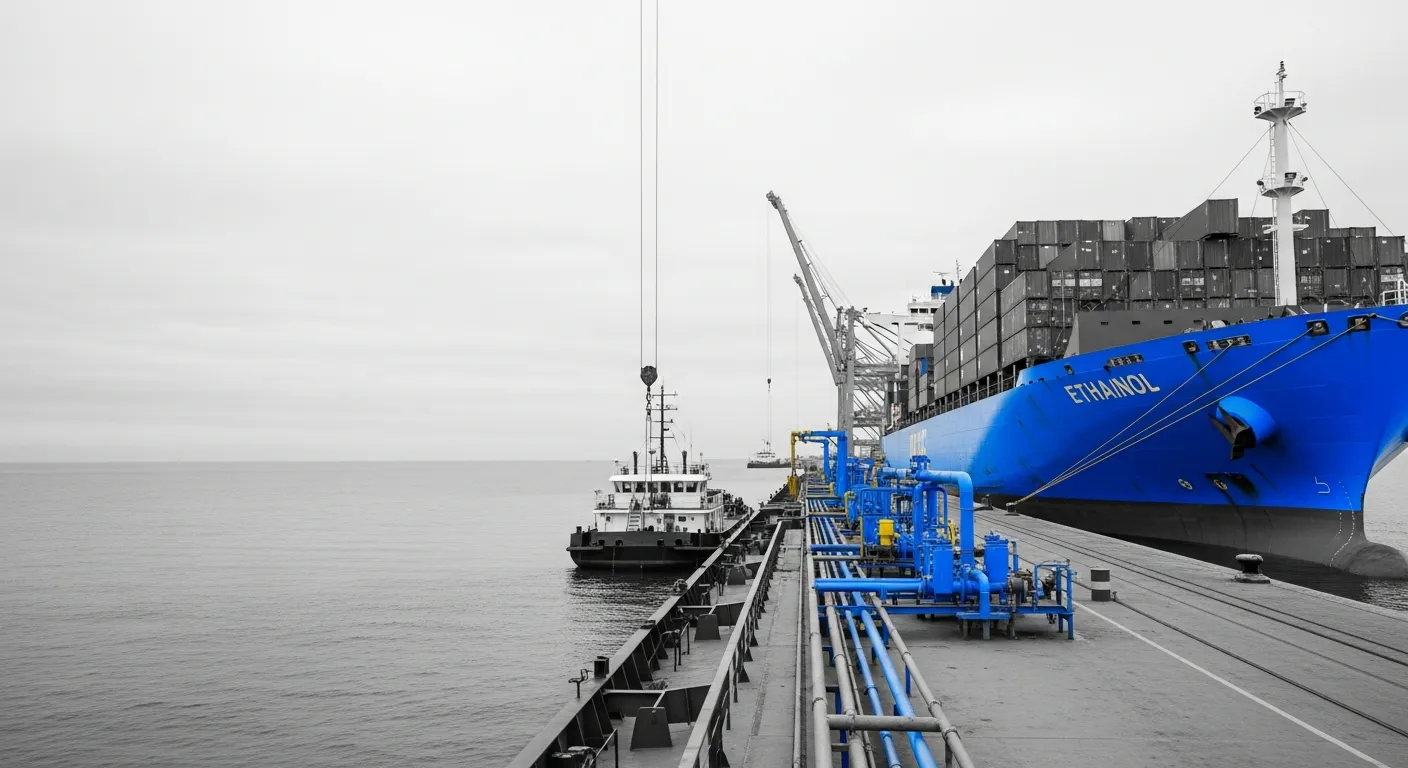
2026 is shaping up to be the year the conversation on ethanol bunkers moves from theoretical to commercial.
From Pilot to Production: Recent Commercial Milestones
In July 2026, Latin America recorded its first deep-sea ethanol bunkering when Bunker One delivered 500,000 litres of bioethanol to CMA CGM IRON at the Port of Santos. The CMA CGM IRON, a tri-fuel certified container ship, successfully completed the operation under controlled conditions, signalling that ethanol has moved beyond laboratory trials into operational reality. This followed May 2026 bunkering at Rotterdam where X-Press Feeders' Eco Levant took on a blend of 90% biomethanol and 10% ISCC-EU certified second-generation ethanol, demonstrating compatibility with existing methanol infrastructure.
These operations are not anomalies. Maersk and Vale have already progressed beyond trial blends (E10, E50) to full 100% ethanol voyages on methanol-capable vessels, confirming vessel performance under production conditions. Commercial operations are expected to scale across major bunker hubs—Santos and Singapore identified as first movers—with more commercial ethanol bunkering operations to emerge over the next 12 to 24 months, according to industry forecasts. This acceleration hinges on a critical asset: the existing methanol-ready fleet that can switch fuels without major engine modifications.
Methanol Fleet as Ethanol-Ready Infrastructure
As of end-2025, approximately 129 ocean-going vessels above 5,000 GT operate with methanol dual-fuel capability, with a further 317 on order for delivery to 2030. Beyond newbuilds, an estimated 1,100 existing vessels are planned for retrofit to methanol dual-fuel operation over the next five years. That pipeline totals well over 1,200 ships that can realistically run on ethanol under IMO safety circular MSC.1/Circ.1621, adopted in 2020 to cover storage, fire safety, machinery systems, bunkering procedures and crew training for both methanol and ethanol fuels.
The regulatory scaffold is already in place. Ethanol shares the same combustion concept and safety architecture as methanol engines, allowing engines like WinGD's X-DF-M—adapted from the proven methanol design—to transition to ethanol with minimal retooling. WinGD's first ethanol-fuelled two-stroke engines, announced for 2026 delivery with retrofits available from 2027, represent the third major advantage: engine manufacturers are confident in both newbuild and retrofit pathways. This reduces the technical and certification risk that has plagued earlier alternative-fuel cycles.
Cost Advantage Drives Fuel Switching Economics
The economic case for ethanol is stark. In June 2026, ethanol priced at approximately $700/mt on U.S. loading basis and above $800/mt delivered into Asia, compared with over $1,000/mt for green methanol and above $750/mt for low-sulphur fuel oil (LSFO). On a global margin, the cost gap between ethanol and green methanol consistently runs $600–$1,400/mt, depending on feedstock and location—a differential that justifies logistics investment and fuel hedging for multinational operators.
This price advantage reflects structural oversupply in ethanol markets. The U.S. Department of Agriculture projects a 17-billion-bushel domestic corn supply for 2025–2026, the largest on record as yield per acre improves. Road fuel demand for ethanol has plateaued in maturing markets (particularly North America and Europe), pushing producers toward new demand channels. Shipping represents a scalable outlet. The Renewable Fuels Association estimates that ethanol capturing just 5% of global marine fuel would increase demand by 4 billion to 5 billion gallons and corn demand by 1.5 billion bushels—an order of magnitude visible in procurement budgets.
Mature Supply Infrastructure Eliminates Build-to-Scale Bottleneck
Ethanol has been traded globally as a bulk liquid commodity for over 30 years using chemical tanker routes and terminal infrastructure. Under MARPOL Annex II, it is classified as a bulk liquid chemical cargo (Pollution Category Z), meaning ports, terminals and crews have established protocols for handling it safely from the cargo side, well before maritime bunker adoption. Ports developing methanol bunkering capability can, with aligned safety protocols, integrate ethanol into the same infrastructure without major capital expenditure.
Singapore's X-Press Feeders bunkered 10% ethanol at Rotterdam using only methanol-specific infrastructure already in place. This matters because ethanol does not require its own fleet from scratch—it leverages the growing methanol bunker fleet. Mass flow metering systems, already mandated in ports like Antwerp-Bruges and Rotterdam from January 2026, apply equally to ethanol. This infrastructure stacking compresses deployment timelines from years to months and radically lowers the marginal capital cost per new fuel route.
Regulatory Pathway Opens for Crop-Based Feedstock
Land-use concerns have historically blocked crop-based biofuels under EU rules, restricting recognition of crop ethanol as a low-carbon compliance tool. But the U.S. regulatory position—underpinned by domestic ethanol industry lobbying—is shifting. The U.S. Indirect Land Use Change (ILUC) framework and Default Emission Factor submission to the IMO could open the door for crop-based ethanol under IMO green fuel rules, aligning U.S. regulatory posture with industry interests and ethanol exporters' commercial incentives.
ISCC-EU certification for second-generation ethanol, evident in Rotterdam bunkering trials, demonstrates that advanced-feedstock pathways exist and are operational at scale. This dual-pathway approach—conventional and advanced ethanol both viable under different regulatory jurisdictions—reduces procurement risk for operators managing global compliance portfolios. A single fuel offering multiple compliance narratives (conventional under cost regimes, advanced under carbon-intensity mandates) appeals to shipowners navigating divergent port and flag-state expectations.
Energy Content Trade-Off Against Volume Advantages
Ethanol contains approximately 35% more energy per kilogram than methanol, meaning ships require less fuel to travel the same distance compared to methanol. However, ethanol still lags conventional fuel oil in energy content, requiring about 50% more fuel by weight to achieve the same energy output as heavy fuel oil. This energy-density penalty drives larger fuel-tank requirements and increased bunker costs per voyage compared to traditional fossil fuels, but remains economically tolerable given the cost-per-tonne advantage against green methanol and increasing carbon compliance costs.
The energy penalty is less severe for regional and short-sea operators where tank space exists and voyage economics favour fuel cost over propulsion efficiency. Container and tanker operators on deep-sea routes will see marginal increases in fuel consumption and tank utilization, but the $600/mt price gap often offsets volumetric penalties. Early adopters—Maersk, Vale, CMA CGM—operate on tight sustainability margins where regulatory recognition and decarbonisation momentum justify operational trade-offs.
What This Means for Fuel Procurement Teams
For operators evaluating 2026–2028 compliance strategies, ethanol offers an immediate, operationally proven alternative pathway that does not require fleet newbuilds or extended regulatory waiting periods. The 1,200+ methanol-ready ship pipeline provides a deployment floor; the commodity-scale supply underpins margin stability; and port infrastructure is already operational. Procurement teams should validate ISCC-EU and equivalent certification availability at intended bunkering ports, confirm methanol dual-fuel engine compatibility with their target vessel classes, and assess feedstock sourcing strategy—conventional U.S. corn-based ethanol for cost certainty versus advanced second-generation options for regulatory upside.
Cost modelling should incorporate feedstock and regulatory volatility: ethanol pricing tracks agricultural commodity cycles more closely than synthetic fuels, and ILUC/DFF policy changes could shift cost competitiveness within 12 months. Contracts should lock feedstock origin and certification pathway (ISCC-EU, voluntary sustainability standards, or policy-driven defaults) to isolate compliance risk from fuel price risk. By H2 2026, the first operator cohort will have 12+ months of operational performance data; procurement decisions made in Q3–Q4 2026 will benefit from real-world bunker delivery, engine performance and regulatory clarification.


