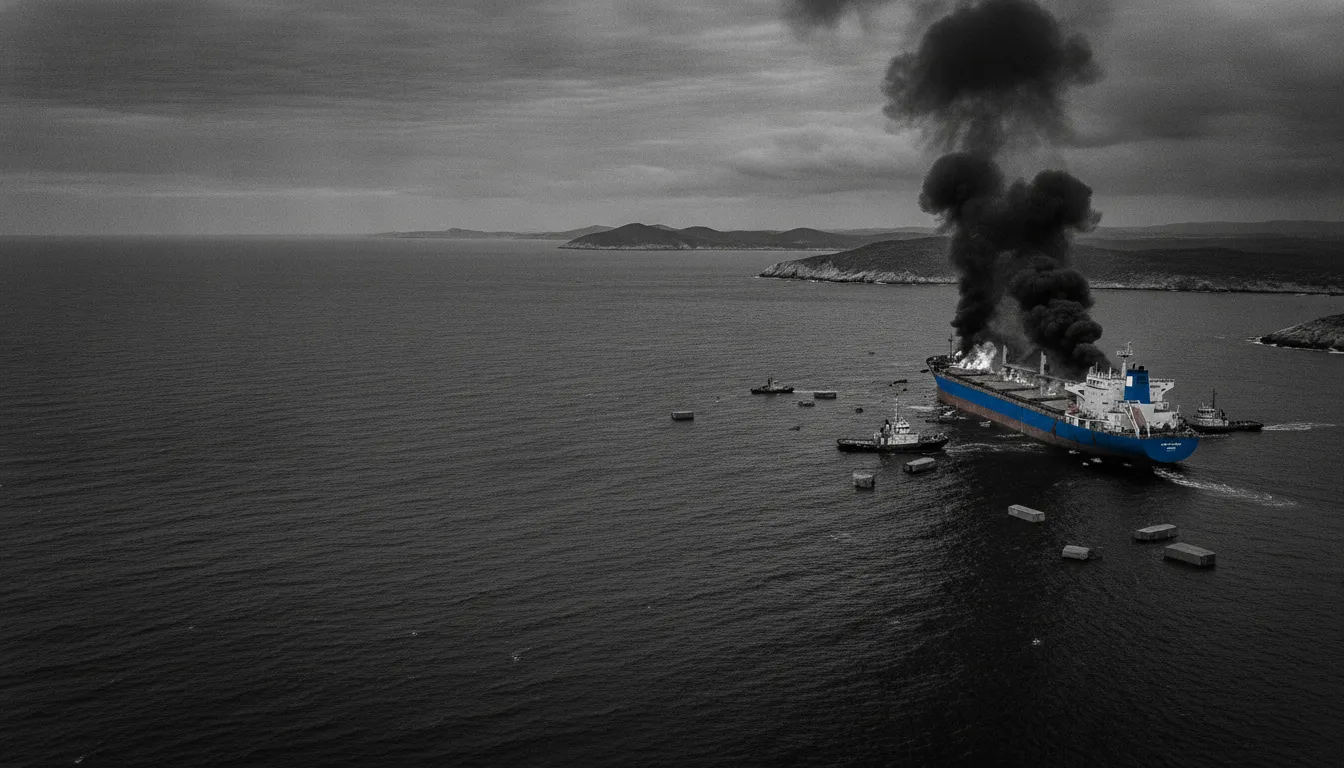
"The closure of Hormuz has forced vessels to reroute from the Gulf toward Asian ports, concentrating demand into fewer bunkering hubs, and breaking the link between supply and access."
The MOU and Slow Strait Reopening
On 17 June 2026, after months of conflict and failed ceasefire attempts, US President Donald Trump and Iranian President Masoud Pezeshkian signed a formal 14-point memorandum of understanding at the Palace of Versailles in France, pledging a 60-day window for negotiations on Iran's nuclear programme, sanctions relief, and freedom of navigation through the Strait. The agreement included explicit commitments to reopen the Strait of Hormuz—through which roughly 20 percent of global oil and liquefied natural gas normally flows—and to lift the US naval blockade of Iranian ports. However, implementation has proved markedly elusive despite diplomatic optimism. As of early July 2026, transit volumes remain at approximately 25 vessels per day, well below the pre-war average of 110 daily crossings. The IRGC Navy continues to enforce altered transit corridors through Iranian territorial waters, redefining the Strait as a broader "operational area" extending from the Iranian port city of Jask to Siri Island. On 19 June, Iran declared the Strait closed again after Israeli strikes in southern Lebanon, contradicting its own foreign ministry within hours—a pattern that has repeated throughout the ceasefire period.
The ceasefire's fundamental fragility matters acutely for bunker markets globally. The disruption forced vessels into massive rerouting via the Cape of Good Hope, adding 10–14 days to transit times and consuming an additional 150–200 metric tons of fuel per vessel at USD 600–700 per ton, translating to USD 1.55–3.07 per barrel in incremental transportation costs. Even as the MOU extends diplomatic hope, the physical recovery timeline remains distant: industry analysts project that full flows through the Strait will not resume until 2027 at earliest. This extended timeline locks operators into elevated bunker costs and extended voyage durations for months ahead.
Bunker Price Spikes and Supply-Side Pressure
Bunker fuel costs have inflated dramatically throughout the crisis and remain persistently elevated even as the ceasefire takes hold. Very low sulphur fuel oil (VLSFO) in Singapore—the world's largest bunkering hub—jumped from USD 486 per metric ton in mid-February to approximately USD 1,000 by late March, a doubling that endures into summer 2026. The price surge was triggered by dual pressures: physical disruption of Gulf supplies and the collapse of heavier crude imports from Iran and Iraq that feed regional HSFO production. Simultaneously, Singapore outbid Atlantic suppliers by USD 250 per ton by late March, a spread that was only USD 26 pre-war. This arbitrage gap reflects acute regional tightness rather than global equilibrium.
The International Energy Agency characterised the Hormuz closure as the largest supply disruption in oil market history. Spot container rates have risen roughly 150 percent since 28 February, with emergency surcharges now stacking upon base rates: USD 1,500 per TEU for war risk premiums, upwards of USD 3,000 per FEU for Persian Gulf-linked cargo, and emergency recovery charges for vessels discharged at alternative ports. Fujairah, the world's third-largest bunkering hub and historically a critical fuelling node for eastbound traffic, has suffered repeated drone attacks on UAE energy infrastructure and depends heavily on higher-sulphur fuel oil (HSFO) imports from Iran and Iraq. Port inventories tightened sharply in March and April, forcing multiple suppliers to declare force majeure. Atlantic Basin refineries have responded by ramping output to peak levels, capturing high refinery margins by funnelling long-haul fuel cargoes eastward via favourable East-West arbitrage economics. Yet this supply rebalancing cannot occur instantaneously; the structural mismatch between supply location and demand concentration persists.
Fujairah's Vulnerability and the Pivot to Asian Ports
Fujairah's traditional role as an indispensable Gulf bunkering anchor has been fundamentally compromised by cascading geopolitical risk and supply isolation. Iranian drone attacks on UAE port infrastructure in March and April forced partial operational shutdowns, and the port's historical reliance on north-Gulf heavier crudes has collapsed entirely as regional flows dried up. The UAE's eastern port was further strained by Iranian missile strikes on energy infrastructure during the conflict's most intense phase. Despite some market participants reporting operational continuity into April, the underlying risk calculus has shifted decisively: bunker buyers and charterers now treat Fujairah as operationally unreliable and geopolitically exposed. Demand has rapidly migrated toward more geographically resilient Asian hubs.
Singapore, the world's largest bunkering centre handling over 50 million metric tons of bunker fuel annually, has emerged as the primary balancing point in global bunker markets. Fuel oil arrivals from Brazil and Russia have offset the loss of Gulf-sourced supplies, with European, African, and North American refiners exporting long-haul cargoes eastward. These supply flows supported seasonal inventory buildups in Singapore by April 2026, easing immediate tightness. Operators increasingly favour geographic flexibility across multiple Asian ports—Singapore, Chinese terminals at Shenzhen and Guangzhou (now offering LNG bunkering operations as of April 2026), and South Korean facilities. This geographic diversification reduces single-hub dependency but demands operational discipline and coordination. Shipowners are adopting sophisticated layered procurement strategies, spreading bunker purchases across multiple dates and locations to hedge volatile pricing swings. Some operators bunker earlier to secure supply at lower anticipated prices; others maintain smaller, more frequent purchases to preserve operational flexibility in markets moving USD 100 per day in price.
Supply Chain Adaptation and Emerging Global Corridors
Bunker traders and refiners have begun reshaping sourcing strategies in real time, responding to structural shifts in supply geography. Atlantic Basin producers now enjoy marked competitive advantages: European, African, and North American refineries are ramping output and exporting long-haul fuel cargoes to Asia via highly favourable East-West arbitrage economics. Tanker and container vessels are being opportunistically repositioned to move fuel across routes; some companies have forgone cargo entirely to transport bunker volumes where prices justify the investment. US–Singapore voyages have become informal fuel corridors, with vessels trading cargo lift for bunker cargo repositioning. Alternative ports like Saudi Arabia's Red Sea facilities (Jeddah, Yanbu), Indian ports, Sri Lankan ports, and emerging Chinese terminals are absorbing overflow demand from major hubs.
The International Bunker Industry Association has characterised the Hormuz crisis as signalling a structural shift in the global marine fuel landscape, exposing fundamental weaknesses in chokepoint-dependent supply chains. Investment in alternative fuels is accelerating visibly: CNOOC completed the first LNG bunkering operation at Shenzhen's Mawan Port on 15 April 2026; Singapore-based bunker traders have launched dedicated new fuels and offshore desks; and ports across Southeast Asia, Europe, and the Middle East are racing to develop multi-fuel bunkering infrastructure supporting LNG, methanol, hydrogen, and biofuels. These capital-intensive investments reflect market recognition that geopolitical vulnerability concentrated in a single chokepoint is no longer commercially sustainable.
Market Fragmentation and Operational Hazards
Bunker supply fragmentation has created acute operational and financial hazards for operators of all sizes. Price discovery remains volatile due to competing sourcing flows and uncertain Strait status. War-risk insurance premiums currently sit at approximately 1 percent of hull value—down sharply from peaks of 2.5–5 percent in March but still triple pre-conflict levels, adding USD 2 million per VLCC transit versus pre-crisis USD 600,000. Vessels rerouting via Cape of Good Hope incur 150–200 metric tons of additional fuel at USD 600–700 per ton. Working capital requirements have tightened across bunker trading: higher fuel prices inflate transaction sizes, and credit conditions have stiffened, exposing smaller suppliers to liquidity strain. Traders with diversified sourcing channels—those not dependent solely on Gulf infrastructure—retain significant competitive advantages.
Buyers must navigate an increasingly complex surcharge environment. War risk surcharges, emergency bunker fees, emergency freight increases, and general rate increases compound cumulatively on base rates. Lead times have stretched by 10–14 days for rerouted voyages via Cape routing. Traditional supply chain models built on pre-crisis transit assumptions require urgent revision. Safety stock calculations must now account for extended voyage duration and documented port congestion; vessel waits of 7–10 days are being reported at some UAE transshipment ports. The mathematics of inventory carrying costs have shifted fundamentally.
What This Means for You
The slow reopening of Hormuz and persistent bunker market fragmentation create immediate imperatives for ship operators, managers, and chandlers. Audit your bunker procurement exposure comprehensively: consolidate surcharge transparency with all major carriers, lock in freight rates where operationally and commercially feasible, and actively diversify sourcing across proven Asian hubs (Singapore, Chinese ports, South Korean facilities) rather than remaining dependent on Gulf nodes. Expand supplier relationships to include Atlantic Basin refiners and emerging alternative regional ports in Southeast Asia and South Asia. Build forward-looking inventory buffers for critical fuel grades, particularly if operating vessels requiring marine gas oil in Emission Control Areas. Engage in dynamic hedging across multiple dates and locations to reduce timing risk in volatile markets where a single day's purchase decision can swing costs by USD 100 per ton. Most critically, assume that even when the Strait reopens physically—a timeline extending into 2027—market tightness will persist for months, war-risk insurance premiums will remain elevated, and structural demand for alternative fuels and multi-hub sourcing strategies will only intensify. The ceasefire has bought diplomatic time and extended negotiation space; it has not restored supply certainty or eliminated the structural vulnerabilities the crisis exposed.