"The issue is no longer whether ships can pass, but whether ordinary commercial traffic can return safely and predictably." An assessment reflecting the operational reality facing fleet operators as Hormuz tensions escalate and procurement teams redesign supply strategies.
The July Crisis: Ceasefire Collapse and Supply-Chain Fragmentation
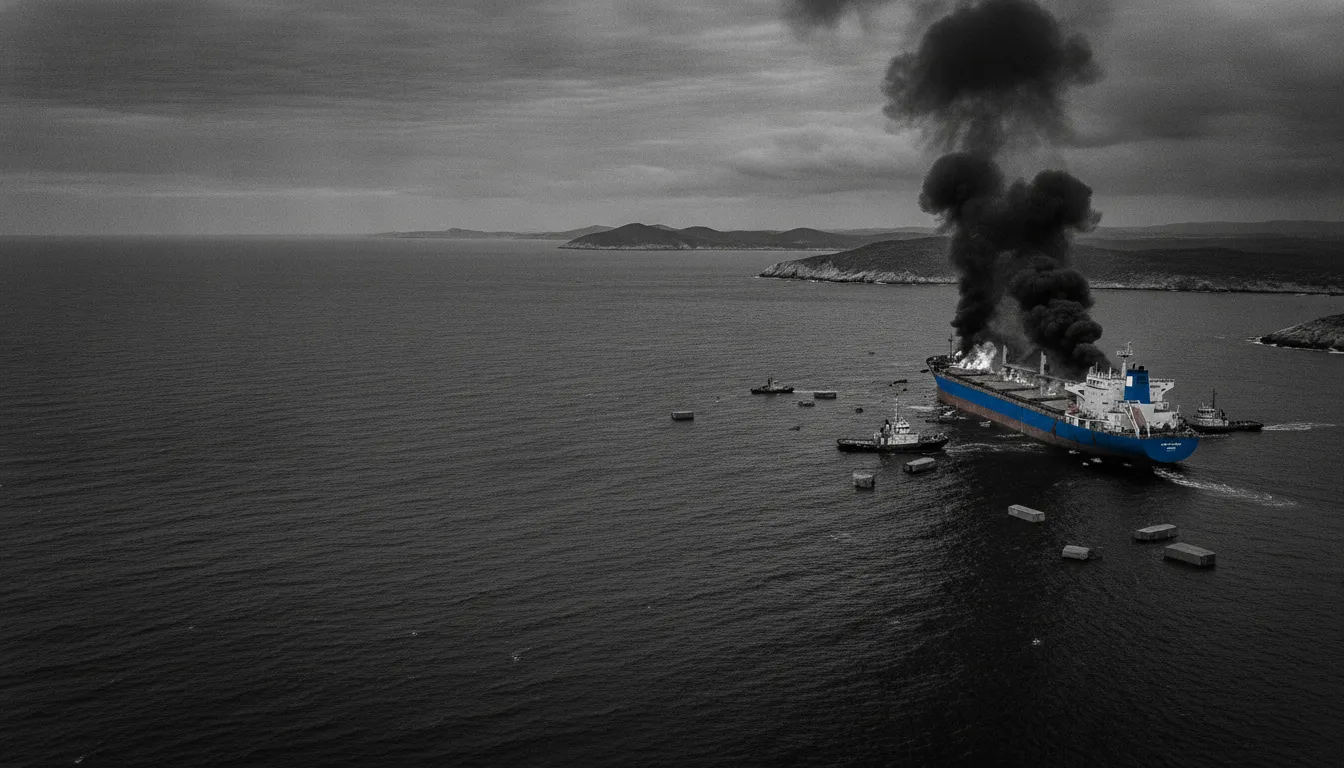
On 7 July 2026, Iran's IRGC fired missiles at three commercial vessels in the Strait of Hormuz across a 24-hour window. According to U.S. Central Command, a Qatari LNG tanker (Al Rekayyat) and a Saudi crude tanker suffered significant damage; crew members were reportedly safe but at least one cargo vessel remained at risk of engine-room fire. The attacks violated a memorandum of understanding signed on 19 June under which Iran had agreed to halt attacks in the strait. By 11 July, U.S. forces had struck roughly 300 Iranian military targets across three nights, targeting missile and drone sites, naval capabilities, ammunition storage, and coastal surveillance positions. Iran declared the strait closed to all traffic; the U.S. maintained that transits were continuing. The truth: uncertainty has become the operational baseline.
Supply-chain reality check: Before the war began in February, Hormuz carried 20–25% of global seaborne oil and comparable volumes of LNG. At the height of military escalation in March, tanker transits collapsed to as few as two vessels per day—down from a normal 120–140 daily crossings. By early July, traffic had recovered modestly to roughly 100–110 weekly vessel movements according to Kpler data, but that recovery now appears fragile. Any sustained closure would move Brent crude prices $20–40 per barrel and drive marine fuel costs up 15–25% within two weeks, according to International Energy Agency modelling.
Bunker Availability Crisis: Singapore and Fujairah Under Stress
The Hormuz closure is not primarily an oil-price story; it is a bunker-supply story. Refinery outages and export constraints tied to Hormuz have fractured global bunker supply chains. In May 2026, bunker prices in Singapore—the world's largest refuelling hub—jumped from approximately $500 per metric ton (pre-conflict baseline) to $800/mt as Gulf production shortfalls squeezed inventories. Marine Gas Oil (MGO) spiked to $1,800/mt, up from the $700s pre-war. Fujairah port, historically the second-largest Middle East bunker hub, suffered operational collapse when Iranian forces attacked port infrastructure in March; operating rates fell below 30–40% of normal throughput. Analysts warn that a prolonged Hormuz closure could create real supply constraints at Asian and European ports within two to three months if Gulf crude flows remain bottled up.
Fleet-operations impact: Bunker shortages transmit quickly into freight rates and wider supply-chain costs. Clarksons Research reported that average container-ship and bulk-carrier speeds fell by approximately 2% from late February onwards as operators reduced fuel consumption by slow-steaming and adjusting schedules. Transport and Environment estimated the crisis was costing global shipping approximately €340 million ($400 million) per day as of May 2026. The compounding effect: reduced vessel speed equals reduced container capacity in the market, which in turn drives freight-rate surcharges. Q3 bunker adjustment factors (BAF) are now being reset quarterly with one-month notice, meaning Q3 surcharges announced in early July will reflect the new crude and fuel-cost reality through September.
Q3 Procurement Playbook: Multi-Port Diversification and Asia-Pacific Hubs
Facing bunker supply fragility, marine fuel procurement teams are abandoning traditional single-hub, just-in-time strategies and rebuilding around geographic redundancy. Singapore remains the world's largest refuelling hub—it recorded 54.9 million metric tonnes of bunker sales in 2024—but Q3 procurement now explicitly hedges against Singapore supply tightness by securing allocations at secondary Asian ports: Shanghai, Zhoushan, and Hong Kong have all expanded multi-fuel infrastructure and shown growth of 1–2% year-on-year. Port Louis (Mauritius) and South African ports (Durban, Cape Town) have benefited disproportionately from Red Sea diversions and Hormuz risk; procurement teams are now building these offline ports into standing contracts to avoid repeat supply shocks.
Operational playbook elements: Ship operators and fuel traders are negotiating longer-term supply commitments (30–60 days forward) at fixed or capped prices to insulate against daily volatility. Procurement teams are explicitly mapping bunker-supply redundancy by carrier alliance and by vessel class (container lines vs. bulk carriers vs. tankers consume different fuel grades). Buyers are stress-testing landed-cost models assuming Brent at $110–$130/bbl and factoring in 0.5–1.5% war-risk insurance premiums on hull coverage—currently 5–10× pre-2023 baseline. For high-value, time-sensitive cargo, some operations are evaluating sea-air transshipment hubs (Dubai, Indian subcontinent) as contingency refuelling points, though this adds cost and logistical complexity. The consensus: treat Hormuz volatility as structural, not transitional.
Rate Mechanics and BAF Resets: How Geopolitical Risk Flows Into Freight Costs
Bunker fuel is a major input to ocean freight costs. According to industry analyst Vespucci Maritime CEO Lars Jensen (March 2026), carriers are implementing bunker adjustment factors quarterly with one-month lead notice. Q2 BAF announcements were made right before the Hormuz crisis; Q3 surcharges, due by early July, now fully embed the new fuel reality. On transpacific routes, spot rates from Shanghai to Los Angeles rose 10% to $2,402 per FEU; Asia–Europe rates remain 25–40% above pre-crisis 2023 baselines, driven by both Cape diversions and fuel surcharges. Container rates have not risen as dramatically as in the Red Sea crisis because demand remains soft and global container capacity is still oversupplied—but the margin for rate softening has evaporated. Any further escalation in Hormuz will suppress spot rates less and squeeze carrier margins more as fuel costs compound.
Q3–Q4 rate trajectory: The 2026 ocean shipping market was initially poised for overcapacity and downward rate pressure, but the outlook has inverted. Red Sea normalization, which was forecast for Q2–Q3 2026, is now indefinitely deferred. As a result, carriers have announced surcharges across Pacific and European lanes. The Joint War Committee (Lloyd's of London) now lists the southern Red Sea, Bab el-Mandeb, the Gulf of Aden, and parts of the Arabian Gulf as high-risk zones requiring additional war-risk insurance premiums on hull and machinery cover. For shippers expecting freight-cost relief, Q3 will be disappointment: fuel surcharges, war-risk endorsements, and congestion effects on alternative routes will all persist.
Supply-Chain Hardening: Multi-Port Contracts and Scenario Planning
Supply-chain teams are embedding geopolitical scenario-planning into procurement cycles. The operational reality is that disruption in the Strait of Hormuz does not manifest as scarcity alone; it manifests as erosion of schedule reliability. Cargo still moves, but transit times lengthen, costs rise, and delivery windows become less predictable. For buyers managing tier-1 logistics networks, the response is threefold: First, diversify bunker sourcing across at least three geographic regions (Asia-Pacific primary, African offline ports as secondary, and strategic reserves at smaller hubs as tertiary); second, negotiate longer lead times (30–60 days) into customer commitments and build buffers for port congestion in both loading and discharge ports; and third, maintain real-time visibility into vessel-fuel consumption, schedule changes, and geopolitical event tracking via logistics data platforms. Procurement teams are working closely with forwarders to track SCFI (Shanghai Container Freight Index) and Drewry World Container Index weekly, and to ensure that all pass-through language for BAF, bunker-related charges, and diversion surcharges is contractually documented before cargo moves.
What this means for Q3 buyers: Do not assume Hormuz will reopen predictably. Plan procurement around 90–120 day forward visibility, secure bunker allocations at multiple Asian ports with fixed price caps where available, and confirm that war-risk insurance follows your routing. Build surcharge buffers into landed-cost models, and communicate revised lead times to your customers explicitly. The new normal is not a return to 2019 conditions but rather a system in which geopolitical tail risk is permanent, bunker supply is fragmented, and procurement agility is a competitive advantage.