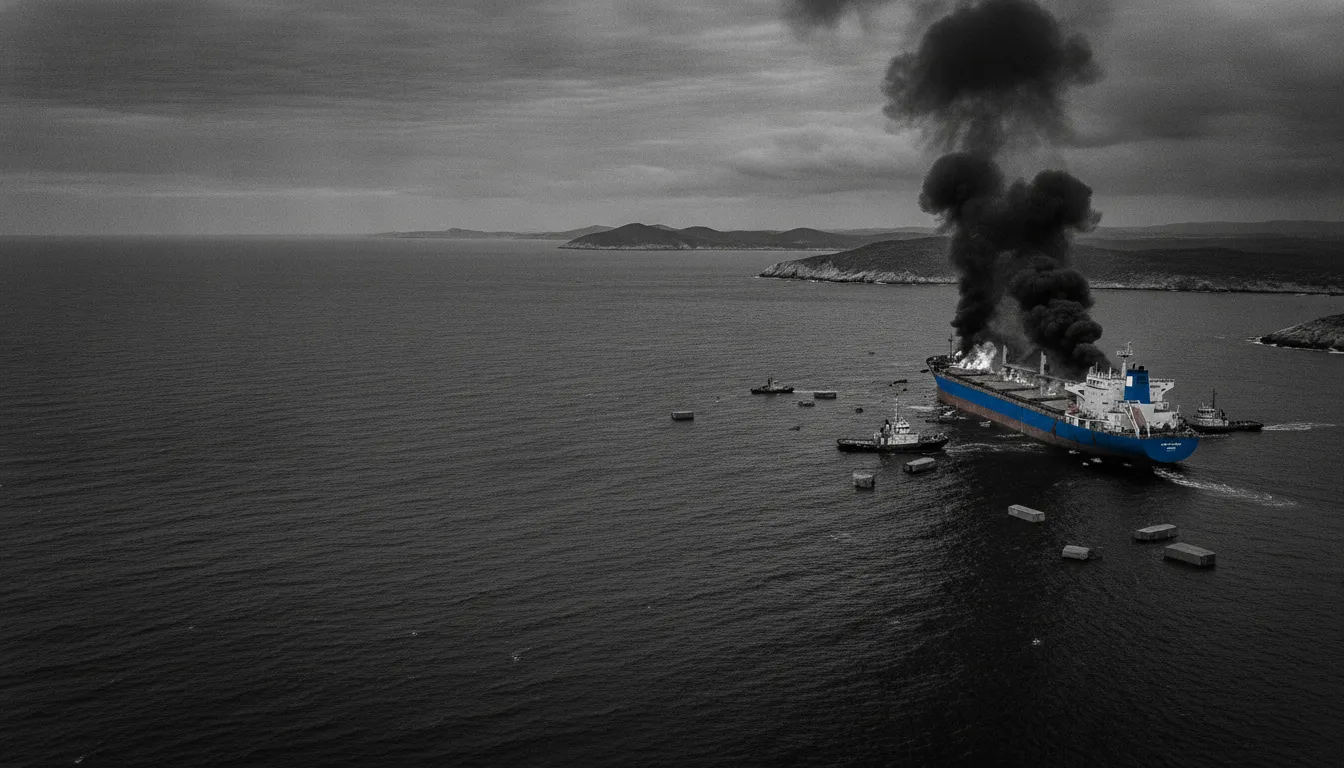
"High volatility and the uncertainty of future supply in many key and secondary ports has created a demand for Term contracts to lock in physical supply and price into the future periods beyond the normal spot market."
The 60-Day Ceasefire Window and Strait Access
On 17 June 2026, US President Donald Trump and Iranian President Masoud Pezeshkian signed a memorandum of understanding extending the ceasefire for 60 days and removing the naval blockade of the Strait of Hormuz. The agreement set the window until 17 August 2026 as a negotiating period for finalising a comprehensive nuclear and sanctions deal. Before the war began on 28 February 2026, the strait handled approximately 20% of global oil and liquefied natural gas flows, with traffic transiting two unidirectional sea lanes at its narrowest point of 34 kilometres. Port operations that had nearly ceased during the conflict have resumed, though full pre-war traffic levels remain months away. The Strait of Hormuz, historically one of the world's most volatile oil chokepoints, is now operationally open—but conditionally so.
However, the memorandum contains explicit preconditions and inherent volatility. On 20 June, Iran claimed it had closed the strait again in response to Israeli strikes in Lebanon, citing breach of ceasefire terms—a claim the US military denied. Shipping continued near the Omani shoreline with vessels disabling automatic identification systems to avoid Iranian detection. Key gaps regarding the release of frozen Iranian assets, reopening protocols, and nuclear programme verification remain unresolved and dominate the 60-day negotiation agenda. The window is thus firm in stated intent but fragile in execution. Any escalation between Israel and Hezbollah, or failure of nuclear talks to yield a final agreement by 17 August, could trigger renewed blockade and supply disruption, making the next two months operationally precious for shipping and supply logistics. Procurement teams must assume the window is not permanent.
Spot Opportunity: Gulf Bunker Pricing Compression
Reopened port traffic and refined product availability in Fujairah, Ras Al Khaimah, and other UAE Gulf bunkering points have created immediate spot surplus. Refineries in the UAE and Iran, offline or throttled for months, are ramping production. Floating storage and barge availability have expanded for the first time since February. Industry sources confirm that spot very-low-sulphur fuel oil (VLSFO) and marine gas oil (MGO) premiums in the Gulf have compressed significantly relative to Singapore and Rotterdam benchmarks. For buyers on voyage-by-voyage or monthly purchasing cycles, spot purchases now offer 8–15 USD/tonne savings versus mid-June levels, depending on grade and delivery port.
The global bunker fuel market reached USD 177.1 billion in 2025, with VLSFO commanding 43.2% of fuel type share as the IMO 2020 mandated sulphur cap standard. Ship & Bunker and independent brokers report that spot premiums—the increment charged above Platts benchmark indices—are at cyclical lows in Fujairah and Port Rashid. Smaller operators and charterers without long-term contracts are seizing the opportunity to top up tanks before onward voyages. Singapore, historically the world's largest bunkering port at over 50 million tonnes annually, now faces competitive pressure from Gulf suppliers offering aggressive spot premiums. The calculus for Gulf spot buyers is straightforward: if you require fuel in July–early August and can accept delivery in the Gulf, current spot pricing is materially attractive. The risk is execution timing: delay by weeks, and the surplus evaporates as demand normalises post-August. Yet this advantage is explicitly time-limited and contingent on ceasefire stability.
Long-Term Contract Risk: Why Suppliers Are Cautious
Conversely, suppliers and major oil companies—which hold a commanding 55.6% seller share in global bunker markets—are hesitant to lock in extended contracts at current Gulf spot prices. The 60-day window expires 17 August, followed by intensive nuclear negotiations. If talks fail or escalation recurs, spot premiums will spike sharply, and any supplier holding a long-dated low-premium contract will absorb significant losses. Historical precedent reinforces this caution: during the 2014 OW Bunker collapse, Singapore spot premiums rose over USD 20/tonne in a single day due to credit shock alone. A return to conflict could trigger far steeper spikes.
Sources from integrated energy majors including Shell, Vitol, and Bunker One have indicated to charterers that 6-month contracts are possible but come with built-in price renegotiation clauses at the 90-day mark, volume minimums of 5,000–10,000 tonnes per month, and force majeure language explicitly covering renewed Hormuz closure. Few suppliers will commit to flat-rate VLSFO supply beyond September 2026 at premium levels negotiated in July. This defensive posture reflects legitimate operational anxiety: a rapid return to conflict would leave suppliers significantly out of pocket on fixed-price commitments made during an artificially benign supply window. Procurement teams seeking longer-term deals must expect either higher base prices, shorter duration, or explicit escape clauses—all of which erode the value proposition of hedging during a temporary surplus.
The Case for Spot: Flexibility and Immediate Gains
Spot purchasing dominates bunker markets globally. Industry estimates suggest 89% of all bunker stems are transacted on a spot basis, underscoring the prevalence of flexible, voyage-by-voyage fuel acquisition. The logic is straightforward: flexibility and simplicity. Vessel schedules shift, charterers redirect routes, and port congestion forces alternative refuelling locations. A spot buyer pays the prevailing price at the dock—currently depressed in the Gulf—and avoids long-term commitment risk. For operators with fluid voyage patterns, no fixed route schedules, or vessels that bunk wherever charterers send them, spot is the pragmatic choice. Procurement teams adopting spot strategies also avoid volume commitment penalties if voyage profiles change unexpectedly.
Data analytics and real-time price monitoring have improved spot purchasing discipline. Traders using platforms like Platts, Bunkerworld, and ClearLynx can model price trends by port and grade, forecasting dips to optimise purchase windows. Given the current Gulf surplus, savvy buyers executing spot purchases in July–early August capture tangible cost savings measured in millions for large fleets. Once premiums normalise post-September and supply tightens, these same buyers would regret having deferred the opportunity. The operational risk is price spikes if ceasefire collapses mid-voyage; the financial gain is certain margin capture if the window holds and is exploited. For operators with working capital and execution discipline, spot is the tactical winner in a 60-day horizon.
The Case for Hedging: Protecting Against Collapse Scenarios
Hedging bunker costs through forward contracts, collar agreements, or floating-price formulae protects against adverse price moves but caps upside gains. Long-term contracts lock in a baseline cost, allowing finance teams to forecast cash flow and voyage profitability with certainty. Research indicates that hedging bunker exposure via fixed-price forward agreements can reduce bunker-adjustment-factor (BAF) volatility by up to 30%, providing material relief for charterers navigating complex freight rate structures. A major container line purchasing under a 12-month formula contract at Platts VLSFO +USD 5/tonne gains operational predictability: voyage costs become calculable months in advance, and CFOs can budget reserve funds with confidence. If spot premiums spike to USD 20+/tonne post-August due to renewed crisis, the hedged buyer smiles; if they fall to USD 2/tonne, the hedged buyer regrets the choice.
Fixed Forward Price (FFP) collar structures—agreements that set a floor and ceiling but allow spot pricing between them—balance protection and optionality. Buyers gain a price cap if markets surge, retain savings if markets fall between floor and ceiling, and guarantee fuel supply without upfront premiums. Industry sources confirm these are attractive during transitional periods but suppliers are currently unwilling to price aggressive collars into the August ceasefire expiry. The fundamental challenge for hedging advocates is that suppliers have priced in collapse risk: extended contracts cost more, or carry renegotiation hooks, reducing the hedging benefit. Operators must weigh guaranteed supply certainty against the likelihood that the premium paid for protection goes unused if the ceasefire holds.
Recommended Strategy: Layered Approach
Best practice for procurers navigating the 60-day window is a layered strategy. Exploit spot purchases for 40–50% of July–August fuel needs at current Gulf rates, capturing immediate savings and maintaining flexibility for schedule changes. Simultaneously, lock 6-month contracts (July–December) for the remaining 50–60% at renegotiated prices, accepting higher premiums in exchange for supply certainty through the critical September–October nuclear negotiation period. Include explicit 90-day price reset clauses and force majeure language covering Hormuz closure. Deploy collar structures where suppliers allow, minimising upfront hedging costs. This balanced approach captures current spot opportunity whilst insuring against September collapse risk. Large fleets and major charterers have sufficient volume leverage to negotiate tiered pricing from suppliers; smaller operators should work through brokers who aggregate demand and negotiate on behalf of buyer pools. The 60-day window is neither purely spot nor purely hedge territory—it demands both.