"The reported attacks threaten to unravel a memorandum of understanding signed less than three weeks ago under which Iran agreed to halt attacks in the Strait of Hormuz." — Axios, 7 July 2026
The July Missile Attacks and Ceasefire Collapse
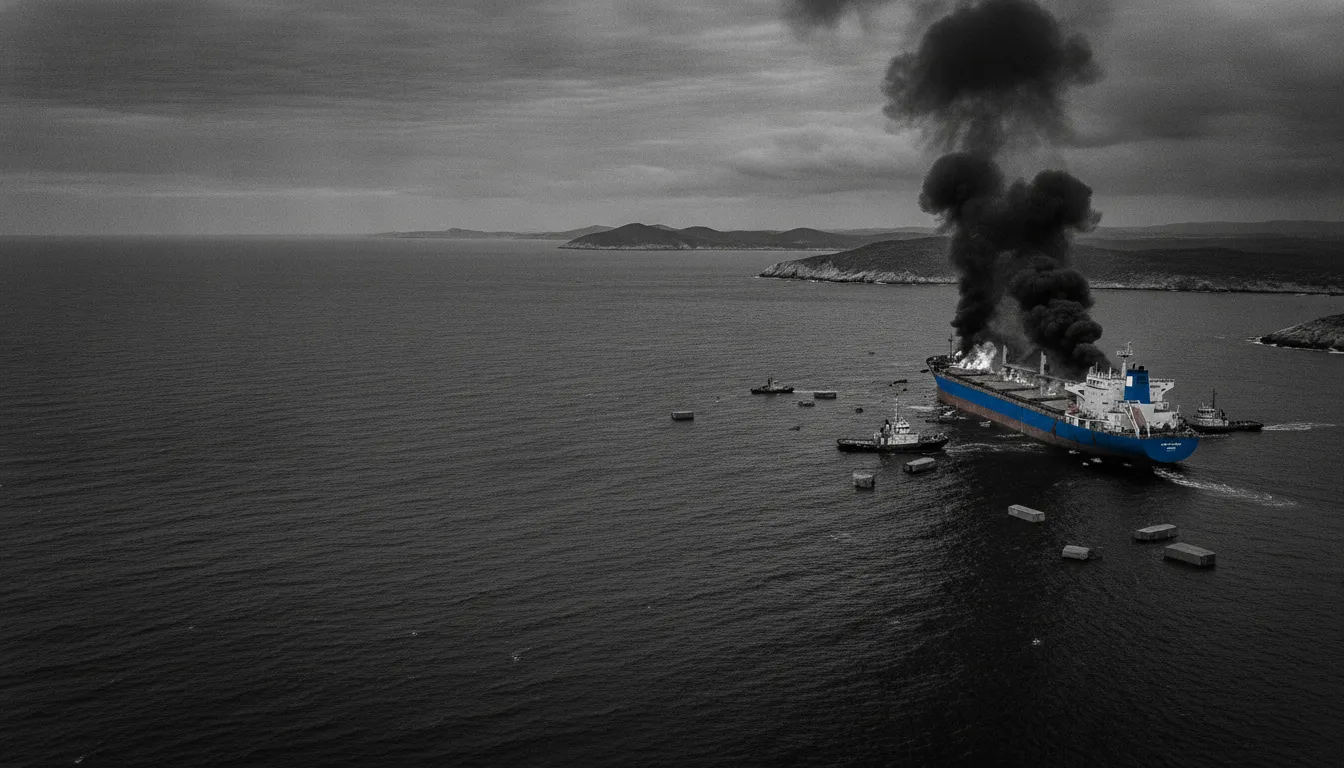
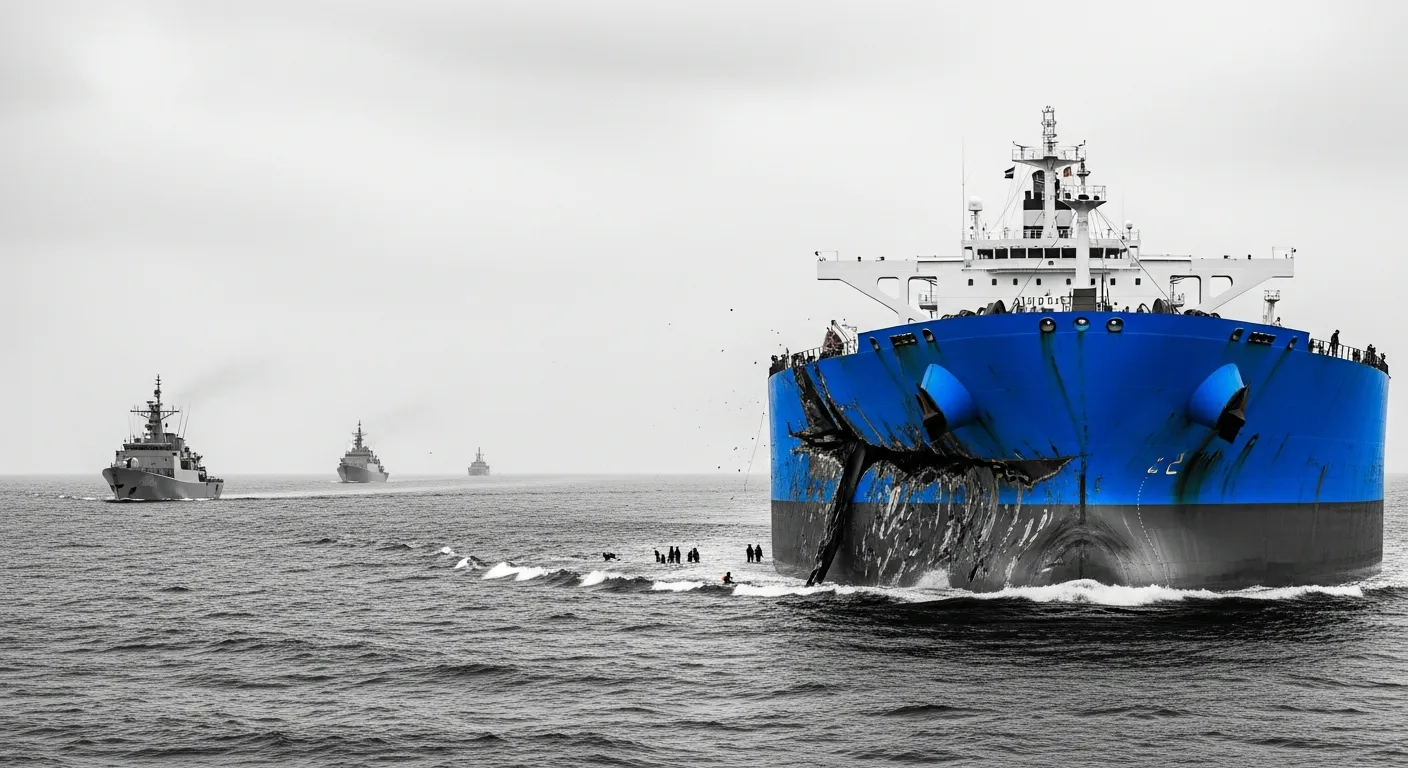
On the night of 6 July 2026, Iran's Islamic Revolutionary Guard Corps (IRGC) fired at least two missiles at commercial ships transiting the Strait of Hormuz, according to U.S. officials quoted by Axios. The United Kingdom Maritime Trade Operations (UKMTO) reported that a tanker was struck by an unknown projectile approximately 8 nautical miles east of Limah, Oman, causing a fire. A Qatari LNG carrier, the Al Rekayyat, was struck in the early hours of 7 July, sustaining significant damage. A Saudi-flagged crude oil tanker was also damaged while exiting the strait. Less than 24 hours later, the IRGC attacked a third vessel. All attacked vessels suffered significant hull damage, though U.S. officials confirmed no crew casualties were reported.
The timing of the attacks proved particularly damaging to diplomatic efforts. The Islamabad Memorandum, signed on 17 June by the presidents of the United States and Iran, had formalized a comprehensive ceasefire and established an explicit 60-day negotiation window to finalize peace terms—meaning the July assault occurred just three weeks into what was supposed to be a stabilization period. The attacks directly violated the ceasefire framework and immediately triggered cascading responses. On 12 July, the U.S. Department of the Treasury reimposed sanctions on Iran's oil exports that had been lifted after the June memorandum signing. U.S. Central Command announced a fresh wave of strikes targeting Iranian air-defence systems, coastal radar sites, and missile and drone capabilities near the Strait. By 12 July, the IRGC Navy had declared the Strait closed after claiming it fired warning shots at a vessel attempting an unauthorized crossing. CENTCOM accused Iran of striking the Cyprus-flagged container ship GFS Galaxy, causing heavy damage to its engine room, with 11 Indian crew members abandoning ship in lifeboats; one crew member remained missing after the attack.
War-Risk Insurance Premiums Spike to 5% and Beyond
The re-escalation has forced war-risk insurance premiums sharply upward. Market data indicates premiums have reached approximately 5% of hull value for a single seven-day transit—a catastrophic spike from the pre-conflict baseline of 0.001% (one hundredth of one per cent). For a $150 million VLCC (very large crude carrier), this translates to a single-transit insurance bill of $5–7.5 million. By contrast, normal peacetime premiums for that same vessel cost $150,000–225,000 per voyage. A $100 million Suezmax tanker now faces a war-risk premium of approximately $5 million per transit at 5% rates, versus $250,000 under pre-crisis terms—a 20-fold increase. For a $150 million container vessel, premiums have risen from around $375,000 to as high as $750,000 to $4.5 million depending on flag state, ownership, and exact routing.
For charterers fixing tonnage on spot markets, this premium becomes a hard cash cost that can exceed the economic viability of a fixture. Container carriers such as Hapag-Lloyd have begun passing the cost through to shipper contracts by implementing war-risk surcharges of up to $3,500 per container on Gulf-touching shipments. The Lloyd's Market Association had affirmed in March 2026 that war-risk insurance remained available, with 88% of underwriters surveyed retaining appetite for hull war risks and over 90% retaining appetite for cargo. However, availability does not mean affordability or commercial viability. Howden Re's April 2026 assessment documented a structural market shift from annual cover to voyage-by-voyage pricing, with pre-existing covers honoured but explicitly not renewed at old terms. Market participants reported that some stranded tankers paid as high as 10% of hull-and-machinery value as Additional War Risk Premium in mid-March 2026, and a crude-laden Suezmax tanker's premium alone reached $7.5 million—actually exceeding the freight value of $6.5 million to its destination. The July escalation confirms that underwriters have adopted an even more conservative posture: repricing is now conducted on a per-transit basis with individual underwriting decisions governing each voyage.
Bunker Sourcing Fragmentation Across Asian, Arabian, and African Hubs
Before the February 2026 war, the Strait of Hormuz accounted for approximately 20% of global oil and LNG flows, with the waterway handling an estimated 120–140 vessel crossings per day. Gulf ports such as Fujairah served as critical regional bunker hubs, supplied by inexpensive feedstock from Iranian and Iraqi refineries. The persistent closure and July re-escalation have fractured that established supply architecture beyond repair. Argus Media reported in early April that Fujairah faced acute shortages of high-sulphur fuel oil (HSFO) and marine gas oil (MGO), both heavily reliant on imports from Iran and Iraq. Very low-sulphur fuel oil (VLSFO), a cleaner bunker fuel used by much of the global fleet, appeared to be available but only in substantially smaller volumes than normal.
Bunker suppliers and ship operators are now forced to diversify sourcing across three distinct regional corridors: Singapore and the eastern Asian coast (Kaohsiung, Port Klang, and secondary hubs); the Red Sea–Suez corridor (Aden, Port Said, Suez); and West African ports (Lagos, Port Harcourt) serving as secondary alternatives. Container shipping operators have already begun imposing war-risk surcharges, with Hapag-Lloyd implementing up to $3,500 per container on Gulf-touching shipments—a direct pass-through of elevated insurance costs. Ship & Bunker and 2050 Marine Energy reported in Q1 2026 that bunker demand at 17 key hubs showed a 4.9% year-on-year gain, driven by rerouting traffic away from the Middle East. Global bunker supply and demand patterns are expected to remain "inconsistent and confused for most of 2026" as disruption to traditional shipping routes continues. For small and mid-sized ship supply firms and chandlers, this fragmentation requires urgent vetting of suppliers at multiple nodes and contractual renegotiation of bunker credit terms across jurisdictions with different payment lag and default-risk profiles. The shift also creates working-capital pressure: stocks that were positioned at a single Gulf hub must now be distributed across three regions, increasing inventory financing costs and complexity.
Supplier Vetting and Credit Risk in Fragmented Supply Chains
The emergency shift to multi-hub sourcing exposes chandlers and buyers to sharp increases in supplier credit risk and operational complexity. Bunker credit stress has deepened due to payment delays, rising compliance risks, and heightened counterparty default risk in secondary markets. Suppliers in Singapore, the Red Sea, and West Africa operate under fundamentally different regulatory regimes, insurance availability frameworks, and political risk profiles. A supplier at Port Said faces Suez Canal Authority payment requirements and Egyptian pound currency exposure; a Lagos supplier may face Nigerian naira volatility, local maritime authority licence compliance, and reputational risk tied to Nigerian port conditions. Buyers must now conduct rapid due diligence on credit ratings, insurance coverage, sanctions screening compliance, and operational capability across multiple counterparties simultaneously—a burden that exceeds the compliance infrastructure of smaller trading firms.
Sea-Intelligence Maritime Analysis reported that container shipping's first-quarter 2026 combined revenues totalled $61 billion, but earnings before interest and taxes (EBIT) were only $2.7 billion—a wafer-thin margin now further eroded by bunker cost spikes estimated at $5.5 billion across the sector. This profitability squeeze forces ship operators to demand tighter payment terms from suppliers: shorter credit windows, higher upfront deposits, and frequent price refreshes tied to Platts or S&P Global benchmarks. Small chandlers operating on 30–60-day payment cycles face acute cash flow compression and may lose transactions to larger, better-capitalized competitors who can absorb cost volatility and offer consolidated bunker sourcing across multiple hubs. The pressure also incentivizes consolidation: independent bunker traders face margin compression and may seek acquisition by larger players or exit the market entirely.
The 60-Day Negotiation Window and Market Uncertainty
The Islamabad Memorandum explicitly established a 60-day window from 17 June (expiring around 16 August 2026) to finalize a comprehensive peace deal. The July missile attacks and subsequent U.S. strikes have thrown that timeline into severe jeopardy. Even if a new ceasefire is announced, historical precedent from March–May 2026 demonstrates that insurance capacity does not automatically snap back. Howden Re's market assessments have emphasized that structural repricing is not reversed by diplomatic announcement alone. Capacity withdrawn at the treaty reinsurance level cannot be reinstated by political announcement; it must be rebuilt through individual underwriting decisions conducted over weeks or months. During the April ceasefire, premiums had eased to approximately 1% of hull-and-machinery value by late March—down from the March peak of 2.5%—but remained eight times higher than pre-war levels of 0.1–0.15%. The Lloyd's Market Association, in June 2026, launched a new marine war risk consortium led by Chubb with participating Lloyd's syndicates, providing up to $200 million of dedicated capacity for hull and P&I risks and an additional $200 million for cargo. However, this facility is not a return to pre-war pricing; it is a structural accommodation of elevated risk at higher premium cost. For operators and traders, the lesson is clear: a ceasefire announcement does not equal route reopening or insurance normalisation. Planning must assume elevated war-risk premiums, volatile sourcing, and multi-hub procurement as the baseline operating environment throughout the remainder of 2026, regardless of negotiation outcomes.