"Iran is weaponising Hormuz geographically to bolster its bargaining power," according to analysts tracking the 2026 Strait crisis. The IRGC enforces only approved routes; vessels using the Oman corridor face missile attack, whilst those signalling compliance via AIS are intercepted for toll negotiation.
Nine Attacks in 11 Days: Deliberate Route Enforcement
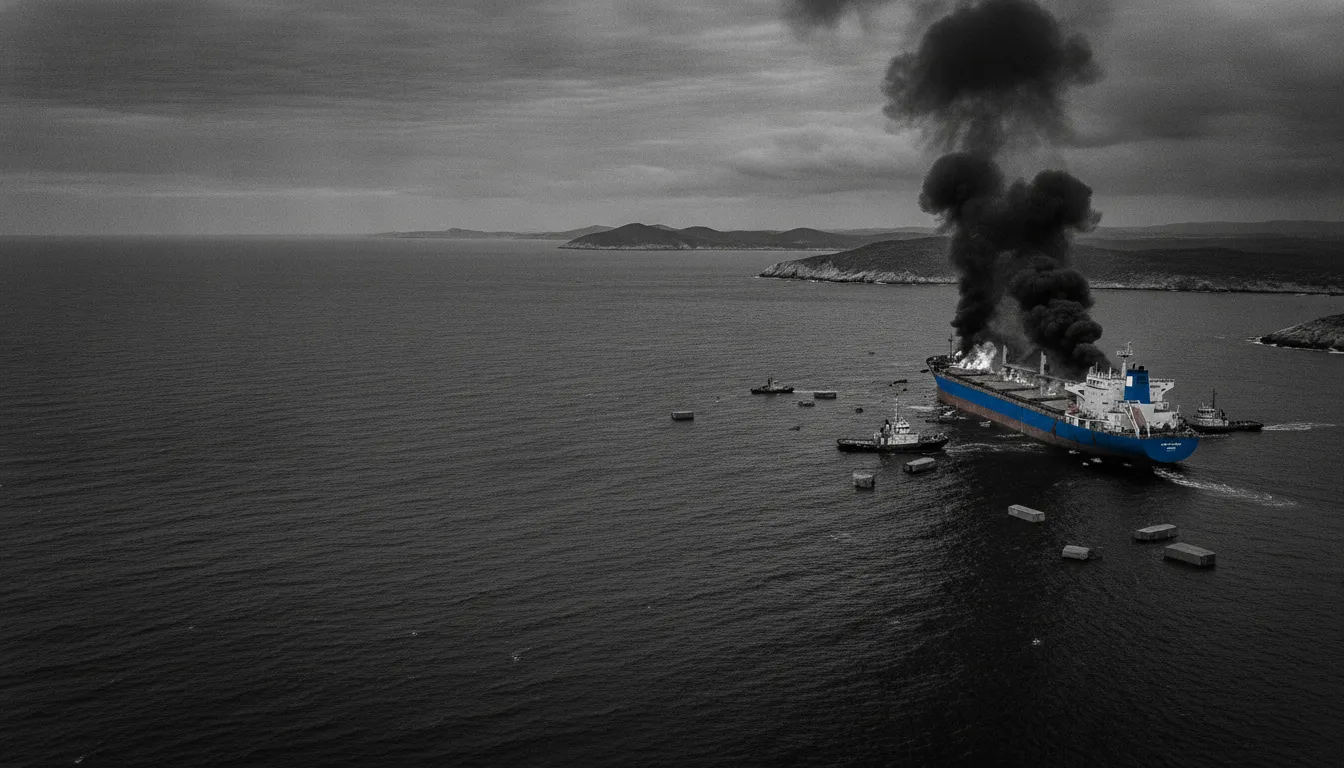
Between 6 and 17 July 2026, at least nine commercial vessels were targeted in or near the Strait of Hormuz. The cycle began on 6 July when Iran's Islamic Revolutionary Guard Corps (IRGC) fired at least two missiles at merchant ships, with a third struck on 7 July—a single day producing the highest attack count since a US-Iran memorandum of understanding (MOU) was signed on 17 June. On the morning of 7 July, Qatar's LNG tanker Al Rekayyat was hit on its port side 15 kilometres off Limah, Oman, by a projectile that ignited an engine-room fire and forced evacuation. Simultaneously, a Saudi-flagged supertanker (Wedyan) was damaged whilst exiting the strait. By 11 July, a Cyprus-flagged container ship (GFS Galaxy) was struck, with one crew member reported missing.
The pattern reveals intent: all attacks occurred when vessels used the southern route near the Omani coast—the officially sanctioned US-coordinated passage. Iranian state television and the IRGC broadcast warnings stating only the northern, Iran-controlled route was safe. This is not random piracy; it is toll enforcement through coercion. According to Al Jazeera reporting, "Iran is weaponising Hormuz geographically to bolster its bargaining power," with Michael Wahid Hanna of the International Crisis Group noting that Tehran aims to "establish a system that recognised its control of the strait and established a mechanism for its monetisation." The IRGC suspended its 60-day ceasefire commitment within weeks, signalling that the MOU framework has effectively collapsed.
Dark Running: Compliance Through Invisibility
Faced with targeted strikes on lit vessels, commercial shipping has adopted "dark running"—disabling Automatic Identification System (AIS) transponders to hide identity, location, and destination. Windward data from late June showed that during a single day when Iran declared the strait closed, "five of eight inbound vessels were dark," with maritime intelligence firm Windward describing the traffic profile as "dark, sanctioned, Iranian-linked." This escalated further by 11 July: all six vessels crossing the strait did so with transponders switched off, according to preliminary Kpler analysis.
Dark running creates new operational burdens: masters must hand-steer, maintain continuous radar watch, drill bridge teams on landmark navigation, delay entry if more than 60 radar contacts crowd within 12 nautical miles, and assume GPS spoofing throughout transit. The UK Maritime Trade Operations (UKMTO) now advises that "active AIS may be a targeting factor," effectively endorsing transponder disable as a survival tactic. However, dark running increases collision risk and eliminates commercial transparency, forcing suppliers to work with incomplete vessel schedules and creating severe bunker-supply forecasting challenges.
Bunker Supply Chains Fractured: Fujairah and Gulf Scarcity
The simultaneous attacks have severed the Gulf's primary bunker supply model. Fujairah, the UAE's eastern port and world's third-largest bunkering centre, is experiencing acute shortages. According to Argus Media head of Middle East products pricing Elshan Aliyev, both high-sulphur fuel oil (HSFO) and marine gas oil (MGO) are in "short supply" at Fujairah—compounded because the port relies heavily on HSFO imports from Iran and Iraq, now blocked by US sanctions enforcement and Iranian port closure. Very low-sulphur fuel oil (VLSFO) remains "available in smaller volumes than normal."
This shortage forces procurement teams to source fuel from non-Gulf suppliers at premium cost and lead time. Singapore, the world's largest bunkering centre, emerged as the primary rebalancing point, with fuel oil arrivals from Brazil and Russia offsetting Fujairah's loss. In March 2026, Singapore VLSFO surged to $988.5 per metric tonne—76 percent above month-start—before moderating to $842.75 by month-end, still 50 percent above baseline. Buyers must now book bunker slots 4–6 weeks in advance at global bunkering hubs rather than rely on short-notice spot purchases in the Gulf, fundamentally restructuring supply chain economics.
Oman and Sohar: Emerging Alternative Hubs
In response, buyers are pivoting to Oman's Port Sultan Qaboos and Sohar port on the Gulf of Oman coast, located outside Iranian control but still accessible to transiting vessels. These ports offer bunker supply but with significantly reduced inventory depth compared to Fujairah pre-war. The UKMTO's Joint Maritime Information Center stated that the route around Oman "has been expanded and remains available for all traffic," yet this southern corridor is now a strike target, not a safe haven. Sohar, whilst strategically positioned, lacks Fujairah's refinery and storage infrastructure and serves primarily as a transshipment point. Buyers must pre-arrange bunker allocations weeks ahead and budget for premiums of 10–15 percent over traditional spot pricing, adding material cost to operating budgets.
Strategic Rerouting and Procurement Lead-Time Expansion
Major shipping lines and operators are formally reconsidering Hormuz transits. Qatar's LNG fleet, operated by state company Nakilat, suspended passages in April and May 2026 after IRGC warnings forced u-turns; the first successful post-MOU transit in June was immediately targeted. Bunker procurement teams must now build 45–60-day lead times for fuel supplies routed via Singapore, Fujairah bottleneck planning, or Sohar pre-positioning. Longer voyage rotations around the Cape of Good Hope—the pre-2021 standard for some operators—are being reconsidered for high-value cargoes, adding 10–14 days to Asia-bound voyages but eliminating Hormuz risk premium.
For ship suppliers and chandlers, this means: (i) stockpiling consumables, spare parts, and provisions at non-Hormuz staging ports (Port Sultan Qaboos, Jebel Ali); (ii) shifting procurement windows to 6–8 weeks to accommodate rerouted supply chains; (iii) pre-contracting with multiple regional suppliers to avoid single-point failure; and (iv) budgeting 5–8 percent premium surcharges on all Gulf-sourced consumables due to extended handling and transshipment.
What This Means for Buyers and Operators
The July 2026 escalation is not temporary volatility—it is strategic regime change in Strait management. Iran has moved from closure threats to selective enforcement, pricing compliance and route discipline through missile strikes. Dark running is now the de facto transit protocol, eliminating schedule transparency and forcing procurement into advance-booking models. Buyers must immediately: (1) Lock 45–60-day bunker contracts with Singapore and non-Gulf suppliers; (2) Establish pre-positioned bunker reserves at Sohar and Qaboos; (3) Extend all supply chain lead times by 4–6 weeks; (4) Budget 10–15 percent cost premium for Gulf-sourced supplies due to transshipment and extended handling; (5) Develop Cape of Good Hope voyage contingencies for high-risk cargoes; and (6) Renegotiate crew rotation and spare parts contracts to reflect new port staging patterns. The era of just-in-time bunker procurement in Hormuz is over. Supply security now demands strategic reserves, geographic diversification, and operational budgeting for sustained premium pricing in a chokepoint under coercive Iranian control.