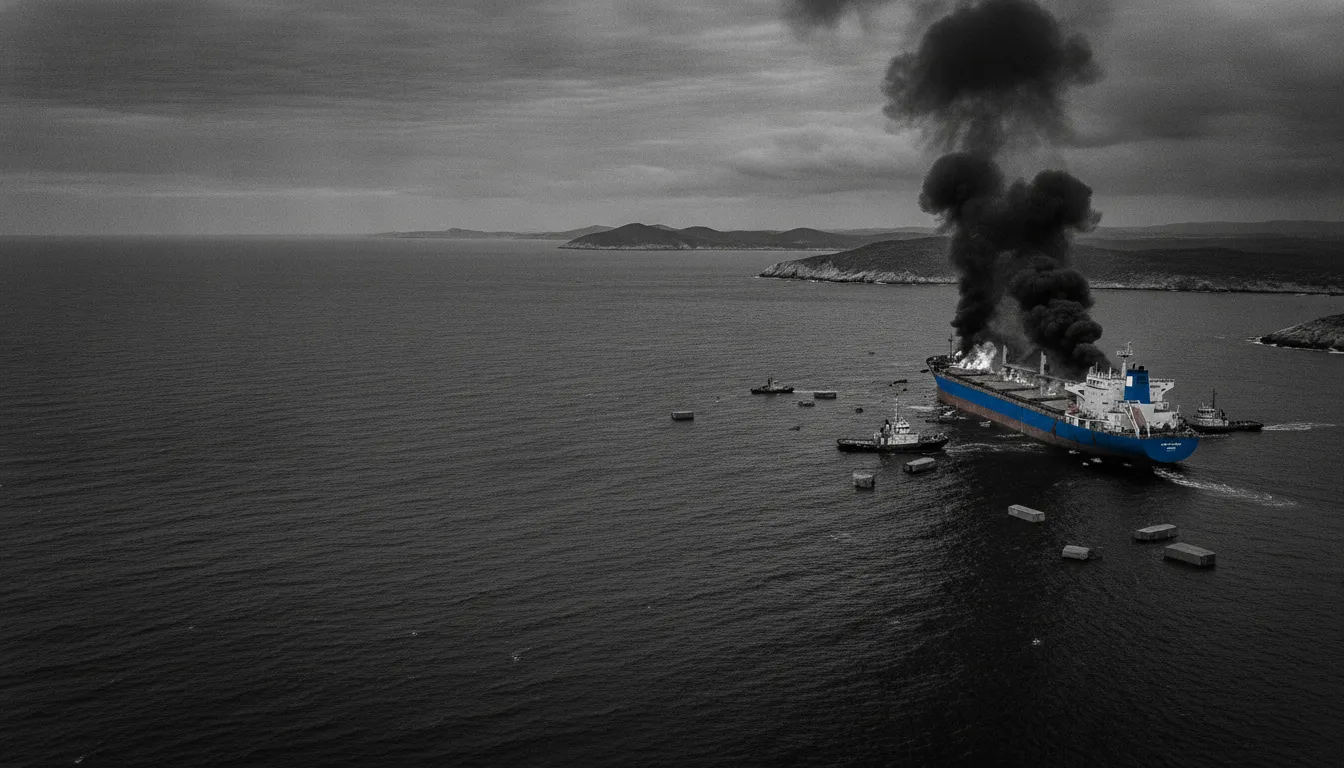
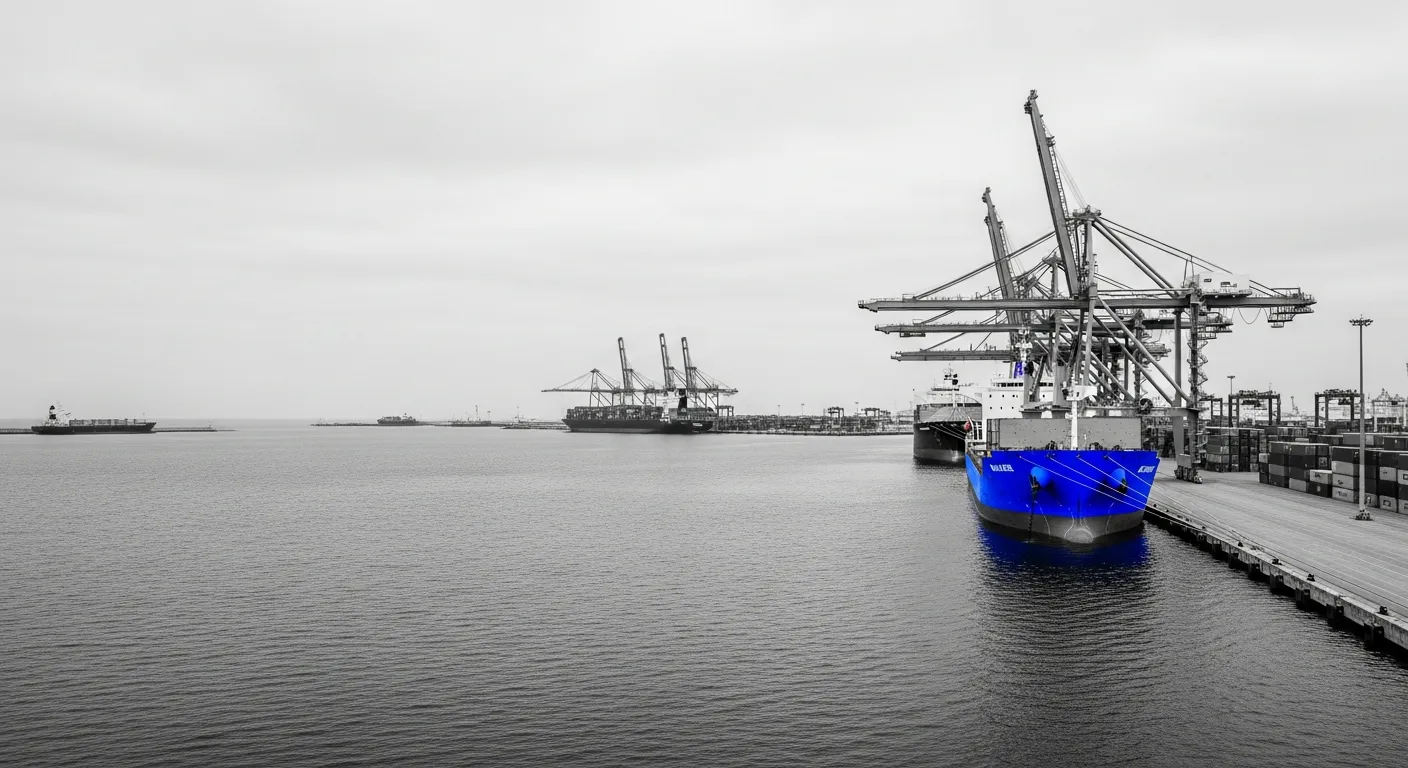
"Oman's deep-water ports of Duqm, Salalah and Sohar in the Arabian Sea outside the strait allow tankers to bypass the chokepoint." This geographic fact has underpinned Oman's strategic transformation since the Strait of Hormuz began functioning as a contested waterway rather than open maritime commons.
Geography as Leverage: Why Oman Controls the Shipping Equation
The Strait of Hormuz at its narrowest point is 21 nautical miles wide. Under the International Maritime Organization's Traffic Separation Scheme, the inbound and outbound lanes span four nautical miles and are separated by a two-nautical-mile buffer. At this critical chokepoint, both lanes lie entirely within Omani territorial waters. Since mid-2025, commercial shipping has shifted wholly into Omani waters to avoid Iranian territorial sea—a pattern that accelerated sharply after 28 February 2026 when US–Israeli strikes closed the strait.
This is not a legal interpretation but a geographic measurement. Omani territorial depth gives the sultanate unprecedented leverage in global trade routing, and this leverage is not temporary. "Oman's neutral geopolitical positioning further strengthens its value as a safe maritime buffer zone," according to regional analysis, and the sultanate's defensive maritime infrastructure—radar pickets on the Musandam Peninsula and a naval base on Ghanam Island—demonstrates that Oman maintains sovereign operational visibility over all transit. The result is a five-node diversion architecture centred on Salalah, Sohar, Khor Fakkan, Fujairah and Jebel Ali, with Omani ports now serving as the primary land-bridge hubs.
Port Infrastructure Expansion Meets Immediate Demand
Before the 2026 crisis, Oman's ports were positioned as strategic alternatives; they are now operational necessities. Duqm, Salalah and Sohar have been equipped and expanded to handle the overflow. These deep-water ports on the Arabian Sea "are designed to support diversified shipping flows that reduce dependency on the Strait of Hormuz corridor." Government-backed port authorities have invested in deep-water terminals, industrial zones and logistics parks to attract transshipment traffic from Asia, Africa and Europe.
Salalah has become the primary Gulf land-bridge hub, recording 26 port-of-destination changes during a single tracking week in April—far above pre-war norms—and 91 transshipment-changed cases, indicating large-scale rewiring of onward cargo connections. Sohar has stabilized as the secondary land-bridge hub, with destination-change cases running at roughly three times the pre-war baseline. Neither port is functioning as a temporary stopgap; both have already transitioned from improvisation to operational normalization. The structural reconfiguration is now embedded. A single Europe–Gulf container rotation that would normally take 25 days via Suez and Hormuz now takes 41 days and costs approximately 25 per cent more, with operating costs rising by USD 300–400 per TEU compounded by emergency bunker surcharges and war-risk premiums.
US Navy Demining Coordination: From Blockade to Corridor Management
The strategic transformation of Oman's role was crystallized by US Navy activity beginning in April 2026. Project Freedom commenced mine clearance operations on the southern Omani route of the Traffic Separation Scheme, with two Navy destroyers conducting autonomous minehunting using unmanned underwater vehicles. These operations were designed to "show that the ships weren't going to hit the mines," using the inshore Omani route as the preferred passage.
On 24 June 2026, Oman announced a new shipping transit route through the strait, coordinated with the International Maritime Organization as maritime traffic resumed following weeks of disruption. Of Monday's 40 daily crossings that week, 10 used the southern Omani route coordinated by the US Navy; the rest used Iran's northern route. This split-route architecture persists and reflects deeper operational reality: the US Navy's demining cleared influence mines in the southern strait, enabling limited safe transit, but escorting large numbers of merchant ships remained improbable due to insufficient US forces. Naval experts argued that eight warships would be needed to escort about 11 merchant vessels, echoing Operation Earnest Will doctrine from the Tanker Wars of the late 1980s. The loss of an Arleigh Burke-class destroyer would be "catastrophic" for US operations. Consequently, the demining cleared the passage but did not restore full confidence. Oman defended its proposed corridor route, saying it was "intended to restore safe navigation while complying with international law." Foreign Minister Badr Albusaidi stressed that "future arrangements related to the strait do not involve imposing any transit fees."
Chandlers and Ship Suppliers Positioned to Capture Diverted Gulf Traffic
Regional ship supply and bunkering demand has already migrated to Omani and UAE coastal nodes. Fujairah emerged as a major global storage and bunkering hub reinforcing its role in supply continuity, even as drone attacks in March 2026 struck storage infrastructure. Omani chandlery operators—including Sea Land Shipping & Logistics (Muscat), operating as the Sultanate's leading ship chandlers, and Oman Chemical International with operations across Salalah, Sohar and the Gulf of Oman—report that provisioning and ship supply services have consolidated around these newly critical nodes.
A typical vessel calling a diverted Gulf port now sources provisions, deck stores, engine spares, bonded items and cabin stores from local chandlers. Oman's geographic position as the intermediary in the Omani-route diversion means its supply base handles not only vessels bound for the Gulf via feeder services, but also container and tanker traffic that would previously have transited directly through Hormuz. The shift is measurable: "Cargo is no longer discharged at the intended Gulf destinations. Instead, it is offloaded at ports outside the Strait, requiring additional inland or feeder transport to reach end markets." This operational change sustains chandlery demand. Omani suppliers are embedded in a functioning logistics system, not a temporary workaround.
Insurance, War Risk and Long-Term Infrastructure Investment
The Joint War Committee of the London insurance market classified waters around Oman as high-risk maritime areas in March 2026, with several drone strikes hitting Duqm and Salalah that same month. However, this classification reflects actual operational volatility rather than commercial unviability. Insurance premiums have risen considerably across the region, yet the five-node diversion system has not collapsed—it has adapted. War-risk insurance, backlog pressure, congestion risk and unresolved transit governance mean the current system has already moved from improvisation into operational normalization.
Long-term investment signals are appearing. The UAE accelerated construction of a second crude oil pipeline to double ADNOC's export capacity through Fujairah, with nearly 50 per cent of the project complete as of May 2026 and expected operational readiness in 2027. Gulf states are expanding incremental bypass systems: expansion of Saudi Arabia's East–West pipeline within Saudi territory, upgrades to Yanbu terminal capacity, and construction of additional storage and bunkering at Fujairah are all scheduled within 3–5 years. These projects require only domestic decisions and could feasibly deliver combined bypass ceiling toward 12–13 million barrels per day, meaningful improvement on the current 8–8.5 million, though still well short of the 20 million barrels per day normally required to fully substitute for a closed Strait of Hormuz.
What This Means for Your Procurement Strategy
If Strait of Hormuz pressure persists—whether through Iranian tolling, mine risk, or continued geopolitical contest—Oman's ports and ship supply ecosystem will remain critically positioned. Buyers, shipowners and suppliers should treat the five-node diversion architecture as structural, not cyclical. For vessel operators planning Gulf calls, routing via Salalah or Sohar, bunkering at Fujairah, and using established Omani chandlery relationships has moved from contingency planning to operational baseline. Procurers should establish direct relationships with Omani ship suppliers now, ensuring they understand local compliance, provisioning lead times and feeder-service reliability. For suppliers seeking growth, the consolidated traffic through Salalah, Sohar and Duqm represents sustained demand visibility. A Europe–Gulf voyage now costs 25 per cent more and takes 41 days instead of 25, embedding a structural cost premium into Gulf logistics that will persist until full demining is complete, Iran–Oman governance frameworks are finalised, and Hormuz operates under uncontested freedom of navigation. Until then, Oman's ports and ship suppliers are no longer secondary—they are the critical infrastructure underpinning Gulf trade resilience.