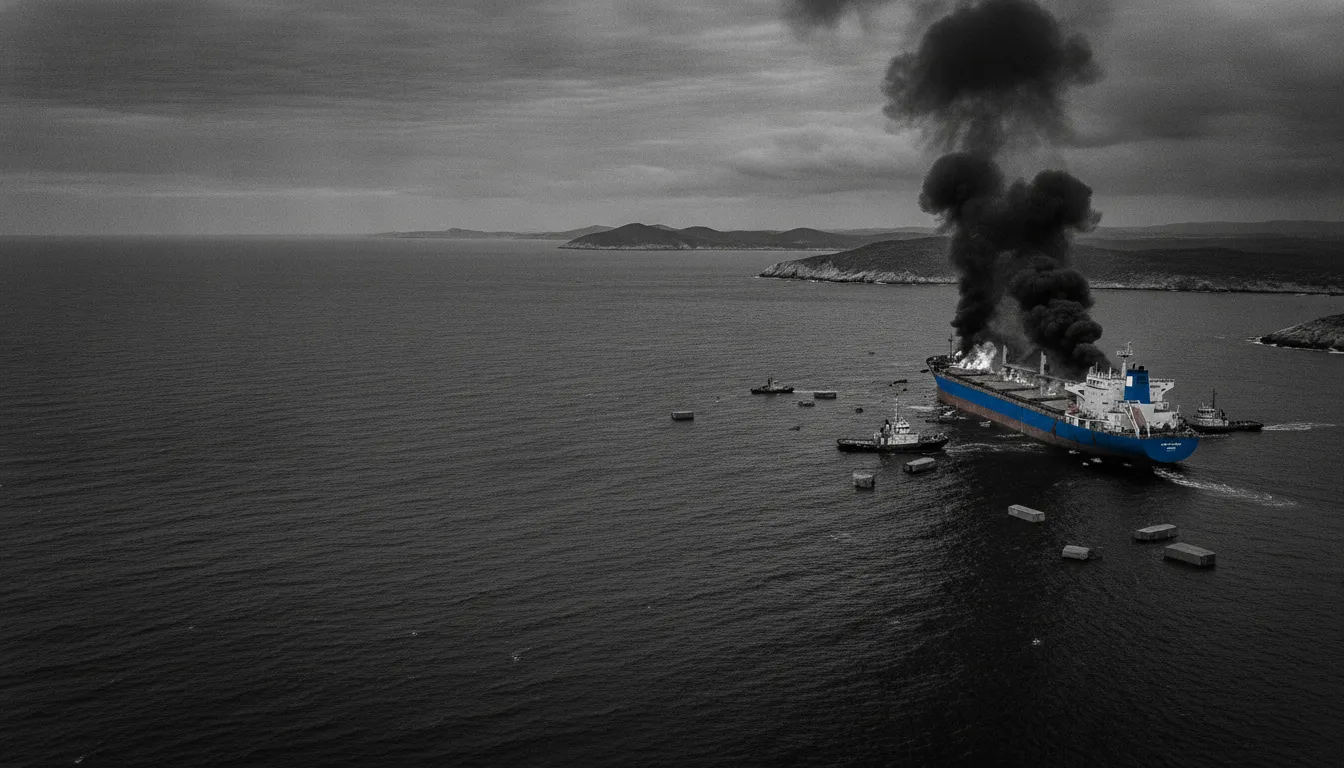
"The industry has lacked a specific, harmonised standard for container losses. These amendments revise Regulations 31 and 32 of Chapter V of SOLAS to align international navigational safety with environmental measures."
Mandatory Container Loss Reporting: From Voluntary Silence to Binding Obligation
Effective 1 January 2026, masters of all vessels carrying one or more freight containers must report container losses without delay to nearby ships, the nearest coastal state, and their flag state under SOLAS Chapter V Regulations 31 and 32. Reports must include vessel identity, position (latitude and longitude or bearing/distance from a landmark), UTC time and date, number of containers lost, cargo descriptions, and UN numbers if dangerous goods are involved. A decade-long average of approximately 1,300 containers lost annually has pushed regulators to eliminate the decades-old voluntary reporting framework. The amendments, adopted through IMO Resolution MSC.550(108) and complementary MEPC.384(81), mandate that flag states upload incident data to the Global Integrated Shipping Information System (GISIS) within the IMO's centralised platform.
For operators, compliance means integrating new procedures into Safety Management Systems, training bridge teams on reporting protocols, and establishing communication workflows with flag state authorities. Initial reports may be submitted with incomplete data if the master cannot determine all required information at the time of incident; however, a final verified report—marked as "final" and containing the full container count—must follow at the earliest safe opportunity. Key figure: Container losses in 2024 reached 576 units, with approximately 200 lost in the Cape of Good Hope region alone (35% of annual total), highlighting the severity driving mandatory reporting. Companies that miss SMS updates or fail to prepare bridge crews face deficiencies during port state control inspections, potential vessel detention, and invalidation of P&I insurance coverage.
Lifting Appliances Move Under Direct SOLAS Control: Comprehensive Equipment Audit Now Mandatory
SOLAS Regulation II-1/3-13, adopted via MSC.532(107), brings all permanently installed lifting appliances—cargo cranes, engine-room cranes, stores cranes, hose-handling cranes, and anchor-handling winches—under direct international statutory control for the first time. The regulation mandates comprehensive testing, inspection, and Safe Working Load (SWL) certification before first use. Design and construction standards apply only to new appliances installed on or after 1 January 2026; however, existing lifting appliances must be tested and thoroughly examined—and permanently marked with their SWL—no later than the date of the first renewal survey on or after 1 January 2026. Guidelines for implementing these requirements are contained in MSC.1/Circ.1663.
The scope is broad: the regulation covers appliances with safe working load below 1,000 kg unless a flag state exempts them. Operators must audit all onboard lifting equipment, verify valid Certificates of Test and Thorough Examination, and ensure a Register of Ship's Lifting Appliances is maintained and accessible. Key requirement: Thorough examination and load testing must be carried out before the appliance is first used and at defined intervals thereafter. Classification societies have launched survey and certification services to meet demand. Existing lifting appliances with valid certificates under ILO Convention No. 152 (Occupational Safety and Health in Dock Work) are grandfathered into the SOLAS scheme with a transition period; those without valid prior certificates must obtain a "factual statement" from a competent person approved by the administration or a recognised organisation. Failure to produce documentation during PSC inspection results in deficiency findings that can lead to detention.
Electronic Inclinometers Mandate: New-Build Container and Bulk Carriers Require Roll Motion Monitoring
New container ships and bulk carriers of 3,000 GT and above constructed on or after 1 January 2026 must be fitted with an electronic inclinometer (or equivalent system) to monitor, record, and display roll motion data to the wheelhouse. The mandate, under SOLAS Chapter V Regulation 19.2.12, is intended to prevent parametric rolling casualties and container losses caused by excessive vessel heeling in heavy weather. Inclinometer data must be integrated with the ship's Voyage Data Recorder (VDR) to support accident investigation and stability analysis. Performance standards for electronic inclinometers have existed since 2013 (IMO Resolution MSC.363(92)), but installation was never mandatory until 2026. Existing vessels are not required to retrofit; only newbuildings are affected. Shipowners placing new-build orders must ensure technical specifications include compliant inclinometer systems and integration protocols with the VDR.
This requirement targets the root cause of catastrophic losses: inadequate crew awareness of vessel movement during cargo operations in adverse sea states. Unlike the container loss reporting and lifting appliance amendments—which apply to all vessels—the inclinometer mandate is narrow and forward-looking, affecting only new tonnage. However, operators with existing fleets face competitive pressure as charterers increasingly scrutinise vessel safety specifications during fixture negotiations. The absence of inclinometer data on older tonnage may influence insurance premiums, vetting outcomes, and charterer acceptance as industry risk management standards evolve.
Port State Control Targeting and Audit Surge: 2026 Detention Environment Tightens
Port State Control inspectors are applying heightened scrutiny as the 2026 amendments take effect. A total of 64 detentions were recorded for DNV-classed vessels in Q1 2026, compared to 52 in the same period in 2025. The Paris MoU detention rate reached 4.03% in 2024, with fire safety as the primary cause; however, new deficiency categories are emerging around SMS implementation, lifting appliance documentation, and container loss procedure familiarity. PSC officers verify that crews can demonstrate understanding of new reporting obligations, lifting appliance maintenance schedules, and inclinometer system operation. Shortcomings in ISM (International Safety Management Code) implementation remain the most significant compliance challenge for operators, as crews must be trained to recognise when procedures meet—or fall short of—documented SMS requirements.
Risk profile calculation: High-risk vessels (poor ISM history, repeat deficiencies, age >15 years) face inspection every 5–6 months under Paris and Tokyo MOUs, whilst low-risk vessels are inspected every 24–36 months. A single detention due to missing lifting appliance certificates or inadequate SMS records on container loss reporting can delay a vessel by weeks, disrupt supply chains, trigger missed charter dates, and escalate future PSC targeting. Non-compliance also invalidates P&I and Hull & Machinery (H&M) insurance policies, creating uncovered liability exposure. Operators who fail to update SMS, train crew, and audit equipment before inspection face commercial penalties far exceeding the cost of proactive compliance.
Supply Chain Urgency: SMS Updates, Spare Parts Verification, and Consulting Demand Spike
The simultaneous entry into force of three major amendments has catalysed urgent demand across the maritime supply chain. Ship supply companies are fielding requests for updated SMS templates that incorporate container loss reporting flows, lifting appliance register formats, and crew training schedules. Compliance consulting firms are experiencing capacity strain as shipowners and managers book pre-arrival PSC audits, deficiency remediation support, and SMS design assistance. Equipment suppliers are prioritising inclinometer system certifications and lifting appliance test documentation to meet newbuild deadlines. Classification societies have expanded survey capacity and issued detailed implementation guidance (MSC.1/Circ.1663 for lifting appliances, MSC.363(92) for inclinometers) to help operators understand phase-in schedules and compliance windows.
Procurement managers are verifying spare parts availability for crane systems, hoist equipment, and monitoring systems to ensure repairs can be executed swiftly if deficiencies are flagged during PSC inspection. Risk management services—including fleet-wide compliance assessments, target audit preparation, and deficiency tracking—have become routine pre-PSC activities rather than reactive responses. What this means for you: Shipowners and managers must prioritise SMS updates now, allocate training time before the next port call, audit all lifting appliances before first renewal survey, and schedule newbuild specifications to include mandated inclinometers and VDR integration. Delayed action creates compounding risk: a vessel arriving at a PSC port without updated SMS procedures, crew training evidence, or lifting appliance documentation will incur deficiency findings, potential detention, charter cancellation, and increased future inspection targeting—all preventable through proactive planning and supplier engagement.