
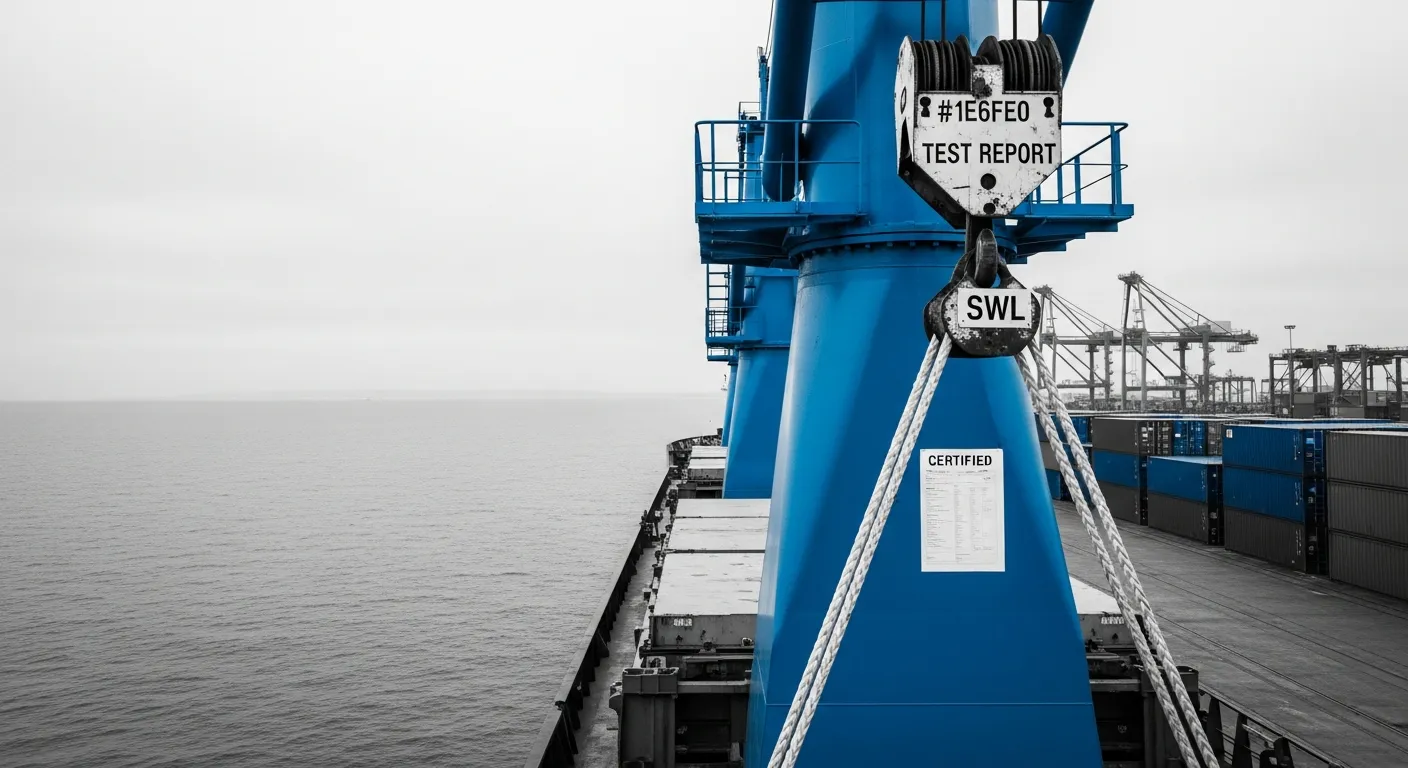
"Lifting appliances installed before 1 January 2026 must undergo load testing and thorough examination no later than the first renewal survey on or after 1 January 2026, with permanent marking and documentary evidence of Safe Working Load."
Regulation in Force: What SOLAS II-1/3-13 Mandates
SOLAS Regulation II-1/3-13, adopted via Resolution MSC.532(107) and now fully effective from 1 January 2026, introduces mandatory safety standards for onboard lifting appliances and anchor handling winches. The regulation applies to cargo cranes, engine-room cranes, stores cranes, hose-handling cranes, hatch cover systems, launch and recovery systems, and associated loose gear aboard SOLAS-certified vessels. New installations must comply immediately; existing appliances face a phased compliance window. Lifting appliances installed before 1 January 2026 must undergo load testing, thorough examination, permanent marking with Safe Working Load (SWL), and proper documentation no later than the first renewal survey on or after 1 January 2026.
Previously, lifting appliances were regulated inconsistently across flag-state rules, classification society notations, and ILO Convention 152, leading to variable safety standards. The new unified regime, supported by IMO Guidelines MSC.1/Circ.1663 (lifting appliances) and MSC.1/Circ.1662 (anchor handling winches), closes regulatory gaps that contributed to preventable accidents. The MSC's decision was driven by increasing accidents involving lifting appliances and winches. Existing certificates issued under other international instruments—such as ILO Convention No. 152—remain acceptable for compliance, reducing duplicative certification requirements while maintaining safety standards. This recognition provides a pragmatic transition path for existing vessel portfolios while establishing clear, global benchmarks going forward.
Compliance Timeline: Two-Track Approach for Operators
The regulation employs a phased implementation model distinguishing new from existing installations. New lifting appliances delivered or installed on or after 1 January 2026 must be designed, constructed, and installed to the satisfaction of the ship's flag state—typically classified society standards—and undergo load testing and thorough examination before first use. They must be permanently marked with their SWL and other essential information. Newbuildings require an IMO Electronic Cargo Gear Book certifying full compliance. Classification societies including DNV, Lloyd's Register, Bureau Veritas, and American Bureau of Shipping have launched comprehensive survey and certification services to support operators through this transition.
For existing vessels, compliance deadlines are tied to class renewal survey schedules, not vessel purchase dates or arbitrary calendar milestones. An operator whose vessel's first renewal survey falls in July 2026 must present compliant lifting appliances by that date; another whose renewal survey occurs in December 2028 has until then. This creates a rolling compliance window throughout H2 2026 and into 2027 that PSC audits are now actively targeting. Class surveyors and Port State Control officers now conduct inspections based on SWL test reports, documented thorough examinations, and permanent equipment marking. A missing or expired load-test certificate constitutes immediate grounds for detailed inspection and potential detention. This phased-yet-rolling schedule places acute pressure on operators whose renewal surveys cluster in late 2026 and 2027.
PSC Enforcement Ramps Up: H2 2026 Audit Focus
Port State Control is the inspection of foreign ships in national ports to verify that ship condition and equipment comply with requirements of international regulations and that vessels are manned and operated in compliance with international instruments. PSC inspections are intended as a second line of defence against substandard shipping. In 2026, lifting appliances and associated loose gear have become a focal enforcement priority alongside existing concerns. PSC officers now examine statutory certificates, equipment condition, and crew competency on lifting operations with heightened rigour.
When a PSCO identifies missing or invalid certificates for lifting appliances during initial inspection, it constitutes clear grounds for escalation to detailed inspection and system-by-system examination. Container, bulk carrier, and general cargo vessels account for 83 percent of PSC detentions. A single detention can cost between $250,000 and over $1,000,000 daily in lost charter hire, demurrage, cargo delay claims, port costs, and remedial work. Operators whose vessels lack proper load-test documentation, permanent SWL markings, or thorough examination records now face heightened risk of detention. PSC databases are shared globally across regional memoranda of understanding, meaning deficiencies recorded in one port state are visible to inspectors worldwide, establishing a permanent compliance record that affects future boarding patterns and targeting logic.
Certificate Gaps and Retrofit Backlogs: Supply-Chain Pinch Points
One of the most acute operational challenges emerging in H2 2026 is the prevalence of certificate gaps. Many existing vessels—particularly older general cargo and multipurpose ships—lack valid load-test certificates or thorough examination records for cranes, engine-room winches, or hatch cover systems installed decades ago. IMO guidelines allow competent third parties to create operations and maintenance manuals for appliances where the original manufacturer no longer trades and historical documentation is unavailable. However, identifying qualified competent persons, scheduling access to vessels, and executing load tests requires coordination and lead time that retrofit yards are struggling to accommodate.
Retrofit supply-chain bottlenecks are intensifying. Equipment supply chain delays for specialized systems—hydraulic components, structural modifications, control systems—routinely extend project timelines by 20–30 percent. With over 3,000 vessels requiring some form of retrofit or inspection work annually, and backlogs and design challenges remaining significant hurdles for timely delivery, smaller operators are finding dock slots booked 12–18 months in advance. Shipyards face capacity constraints; fewer than 400 retrofit yards handle global demand. Sourcing critical components such as hydraulic systems and specialized electrical equipment frequently delays project timelines. The convergence of SOLAS 2026 lifting appliance compliance deadlines with existing retrofit demand—vessel upgrades for fuel efficiency, ballast water treatment, and emission controls—has created a supply-chain crisis in the latter half of 2026.
Maintenance and Spare-Parts Demand Surge
The compliance imperative is driving urgent demand for maintenance services, spare parts, and load-testing facilities. Annual and five-yearly testing intervals for anchor handling winches, plus quinquennial load testing for cargo cranes per MSC.1/Circ.1663 Table 1 values, demand comprehensive thorough examination, major component overhauls, wire rope replacement, and re-certification. Operators are competing for limited engineering capacity at classification societies and approved third-party inspectors. Lloyd's Register, DNV, Bureau Veritas, and other recognised organisations are managing surging workload demand; survey slots for 2026 H2 and early 2027 are heavily booked.
Spare-parts procurement is equally constrained. Cylinder replacements, slewing bearing refurbishment, main winch drum overhauls, and wire rope supplies are in high demand. Manufacturers of specialised marine hydraulics and deck machinery report extended lead times. Operators who defer compliance or procrastinate face compounded costs: rushing repairs into already-full yards inflates labour costs, expedited component sourcing commands premiums, and vessel downtime translates directly to lost revenue. The operators meeting SOLAS 2026 efficiently are those who digitalised their compliance infrastructure early and commenced load testing and documentation in Q1 2026, rather than scrambling at the last minute.
What This Means for You
Shipowners and managers must act now to audit all lifting appliances onboard against SOLAS II-1/3-13 requirements, identify your vessel's next class renewal survey date, and establish a compliant load-test schedule well in advance. Verify whether your existing certificates under ILO 152 or other recognised instruments are valid and on file; gaps trigger expensive third-party surveys. Book yard slots and engineer availability immediately for H2 2026 and early 2027 slots; delays compound costs. Procurement teams should engage spare-parts suppliers and lifting-equipment manufacturers now to lock in delivery timelines and manage lead-time risk. Compliance is no longer optional—PSC officers are now actively detaining vessels with missing or invalid lifting-appliance documentation, and detention costs dwarf the expense of proactive compliance.


