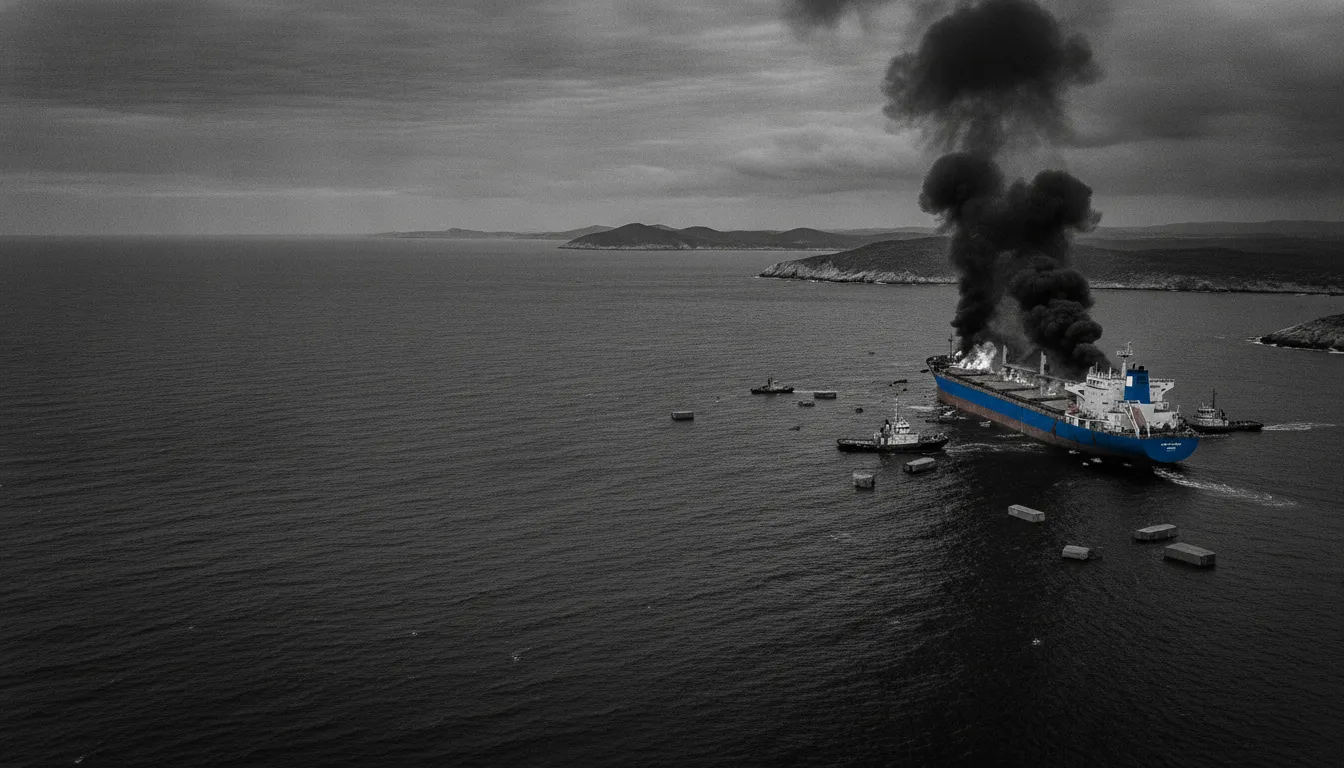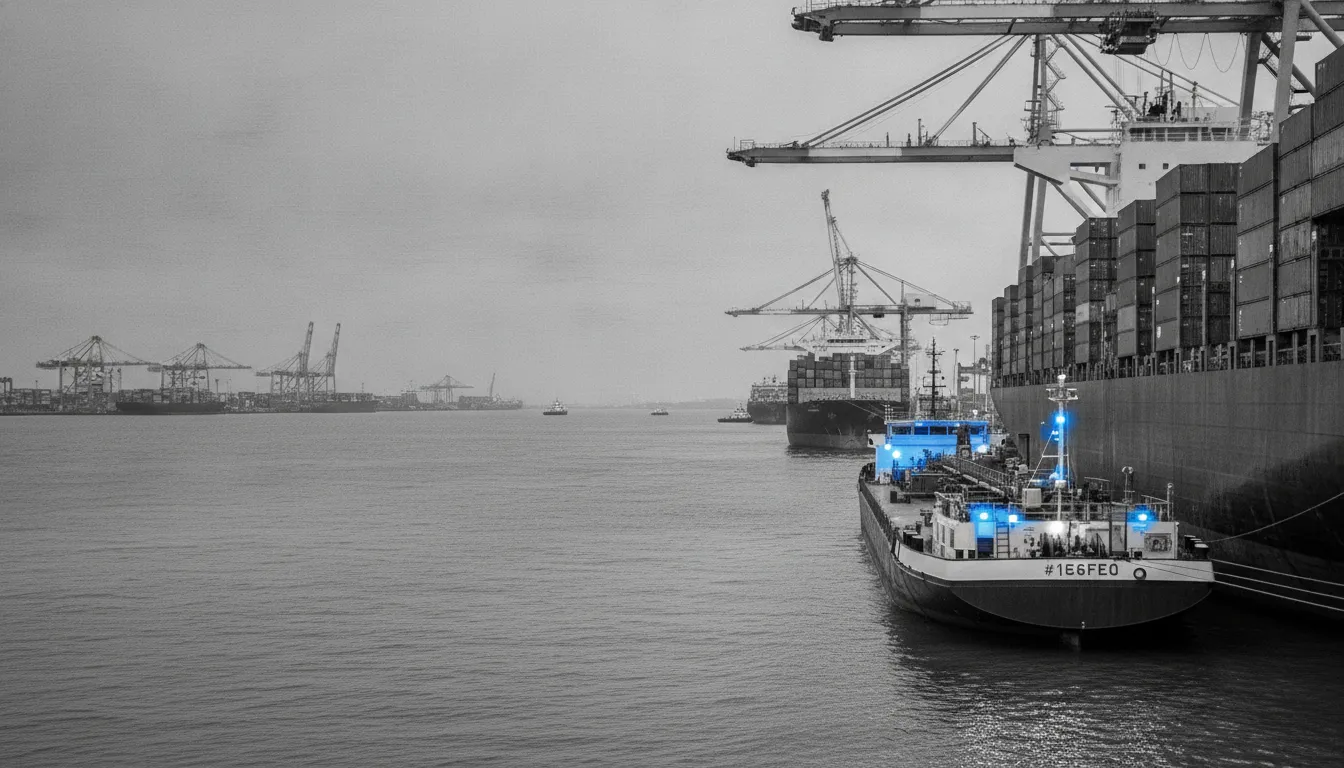
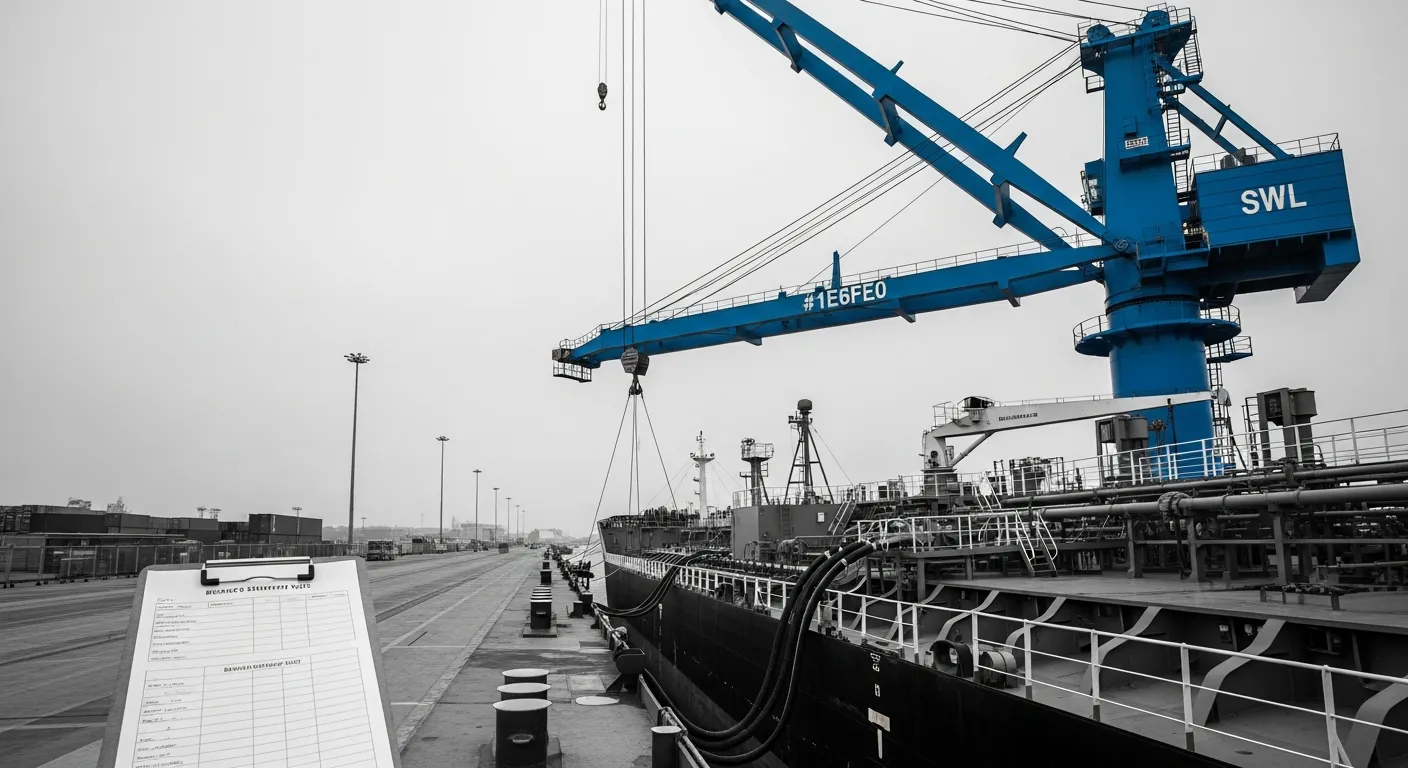
"From 1 January 2026, new SOLAS amendments require bunker suppliers to confirm before delivery that bunker fuel meets minimum flashpoint rules, and all lifting appliances installed before 1 January 2026 must undergo load testing and thorough examination."
The Lifting Appliance Mandate: SWL Certification at First Renewal Survey
SOLAS Regulation II-1/3-13, adopted through IMO Resolution MSC.532(107), mandates uniform safety standards for permanently installed lifting appliances across cargo cranes, engine-room cranes, stores cranes, and hose-handling gear. The regulation entered force on 1 January 2026, but its compliance trigger is staggered: new lifting appliances must be certified and load-tested before installation, whereas existing appliances installed before 1 January 2026 must comply by the date of the first renewal survey (Safety Construction Certificate renewal for cargo ships, or annual Passenger Ship Safety Survey) on or after that date.
This creates a two-phase compliance deadline. Shipowners now face retrofit audits to identify which appliances have valid certificates under acceptable standards (such as ILO Convention No. 152, classification society notations, or MSC.1/Circ.1663 guidelines). Equipment lacking valid test and thorough examination certificates must be load-tested, nominated with an SWL (where manufacturer documentation is unavailable), and permanently marked with SWL and supporting documentary evidence. Non-compliant appliances cannot be used until remediated by a competent person.
Aging Equipment and Certificate Gaps: The Retrofit Urgency
Survey and classification societies now report acute pressure from shipowners seeking pre-survey audits and retrofit planning. For vessels with aging stores cranes, derricks, or engine-room lifts—equipment installed before formal SOLAS regime—documentation is often incomplete: manufacturers may be defunct, manuals missing, and no load-test records on file. Owners must nominate the SWL themselves (subject to flag state approval) based on operational manuals, drawings, or a formal company declaration, then arrange load testing by a competent person recognized by the flag administration or classification society. A single fleet-wide audit can reveal 20–40% of appliances lacking compliant documentation, triggering cascading test schedules and costs.
The logic is safety-critical: load testing verifies that the appliance and its associated loose gear (slings, blocks, shackles) can withstand 1.5 times the SWL without permanent deformation or failure, with test loads calculated per MSC.1/Circ.1663 guidelines. Once tested and examined, a Certificate of Test and Thorough Examination must be issued and recorded in the ship's Register of Ship's Lifting Appliances and Cargo Handling Gear. Thereafter, all appliances require annual thorough examinations and load tests at least every five years—costs that ripple through planned maintenance systems and SMS protocols.
The Bunker Flashpoint Trap: Pre-Delivery Declarations and BDN Audit
Parallel to lifting appliance overhaul, SOLAS II-2/4.2.1 (amended by IMO Resolutions MSC.520(106) and MSC.550(108)) now requires bunker suppliers to issue a signed, certified declaration prior to bunkering, confirming that the actual oil fuel batch meets the 60°C minimum flashpoint threshold established in ISO 2719:2016 (Pensky-Martens closed cup method). This declaration must specify the test method used (ASTM D93 or ASTM D7094 for marine fuel) and state either the measured flashpoint value or a statement that it has been measured at or above 70°C.
The bunker delivery note must now explicitly include flashpoint data. Critically, the 2026 amendment closes a long-standing loophole: bunker suppliers historically guaranteed compliance with SOLAS and ISO 8217 specifications through Material Safety Data Sheets and commercial contracts alone—yet low-flashpoint fuels still reached ships, causing fires in machinery spaces. The IMO's response is unprecedented accountability: no certified pre-delivery declaration, no bunkering. Authorities are mandated to notify the IMO of any confirmed low-flashpoint cases and take enforcement action against suppliers. Disputes are inevitable where on-board testing detects sub-60°C fuel, and owners/managers must retain all correspondence and sample records in anticipation of flag state and port state investigations.
Chandler and Supply Chain Compliance: Crew Training and Supplier Vetting
Ship suppliers and chandlery operations must now embed new protocols. Pre-delivery verification of bunker supplier credentials is non-negotiable: confirm that the supplier holds an accredited laboratory certification and can produce ISO 2719:2016 test reports for each fuel batch prior to delivery. Procurement teams should include express contractual clauses requiring suppliers to warrant SOLAS flashpoint compliance, provide pre-delivery declarations, and maintain insurance covering product liability and credit risk. For owners bunker at multiple ports—Singapore, Rotterdam, Fujairah—supply chain variability is acute; mixing batches from different refineries with differing chemical composition can yield unexpected flashpoint drops.
Crew training on new BDN protocols is now mandatory. Deck and engine officers must verify that the flashpoint declaration is present before opening manifold valves, understand the test method used, and flag any discrepancies to the master. Ship managers should revise their Planned Maintenance and Safety Management Systems to include pre-bunkering checklist items: flashpoint value confirmation, supplier credentials, delivery-note receipt, and sample retention. Disputes over flashpoint off-spec fuels are spiking; operators should engage independent fuel-testing services (such as Lloyd's Register's FOBAS) to validate cargo tanks pre-use and create audit trails if testing later indicates non-compliance.
Regulatory Interconnection: MARPOL Annex VI and Flag State Enforcement
The flashpoint requirement aligns SOLAS II-2/4.2.1 with earlier amendments to MARPOL Annex VI Regulation 18, which came into force on 1 May 2024. However, MARPOL compliance alone is insufficient under the new SOLAS regime: MARPOL requires BDN documentation, but SOLAS now mandates prior written certification from the bunker supplier before delivery begins. Port state control inspections increasingly cross-reference both regimes, and if low-flashpoint fuel is confirmed, port authorities are obligated to report the finding to the IMO and take action against the supplier. Ships operating under certain flag states (e.g., Panama, Liberia, Marshall Islands) should verify that their administration has issued guidance on enforcement timelines and acceptable test methods.
Non-compliance carries operational and financial consequences: vessels detained for lifting appliance certificate gaps, or refusal of bunkering supply due to missing flashpoint declarations, directly interrupt trading schedules. For smaller operators and emerging-market shipowners with aging fleets, the combined cost of retrofit audits, load testing, crew retraining, and enhanced supplier vetting is substantial—yet deferral increases detention risk as port state control enforcement escalates post-January 2026.
What This Means for You: Action Checklist for Operators and Suppliers
For Shipowners and Managers: Commission a comprehensive lifting appliance audit now, identifying all equipment installed pre-2026 and existing certification status. Engage your class society to schedule load tests and thorough examinations before your first renewal survey post-1 January 2026. Revise your SMS and PMS to embed annual thorough examinations and five-yearly load test cycles. For bunkering, establish a pre-delivery verification protocol: confirm supplier credentials, require ISO 2719 test reports, and ensure crew receive training on BDN flashpoint verification and documentation retention.
For Chandlers and Ship Suppliers: Vet all bunker suppliers against SOLAS II-2/4.2.1 requirements—confirm they hold accredited lab certification and can produce pre-delivery flashpoint declarations in writing. Include contractual clauses requiring ISO 2719 testing and product liability insurance. Brief vessel masters and chief engineers on the new BDN requirement and crew responsibilities for pre-bunkering checks. Provide sample-retention guidance and dispute-resolution contact information. For lifting appliance suppliers or spare-parts vendors, ensure all replacement gear (slings, blocks, shackles) includes proof-test documentation and SWL markings per MSC.1/Circ.1663.