"The master of every ship involved in the loss of freight container(s) shall communicate the particulars of such an incident by appropriate means without delay... to ships in the vicinity, to the nearest coastal State, and also to the flag State."—SOLAS Chapter V, Regulation 31 (effective 1 January 2026).
The Scope: Who Must Report, and What Triggers Obligation
The new regulation applies to any vessel carrying one or more freight containers, and to any ship observing drifting containers at sea. This includes general cargo ships occasionally carrying containers on deck, tankers spotting adrift boxes, and bulk carriers in container zones. Resolution MSC.550(108), adopted at the IMO's 108th Maritime Safety Committee session, establishes the framework; MARPOL Protocol I amendments (MEPC.384(81)) align environmental reporting to avoid duplication. The scope is deliberately broad: every vessel type is a potential reporter, making compliance an enterprise-wide responsibility rather than a container-ship-only affair.
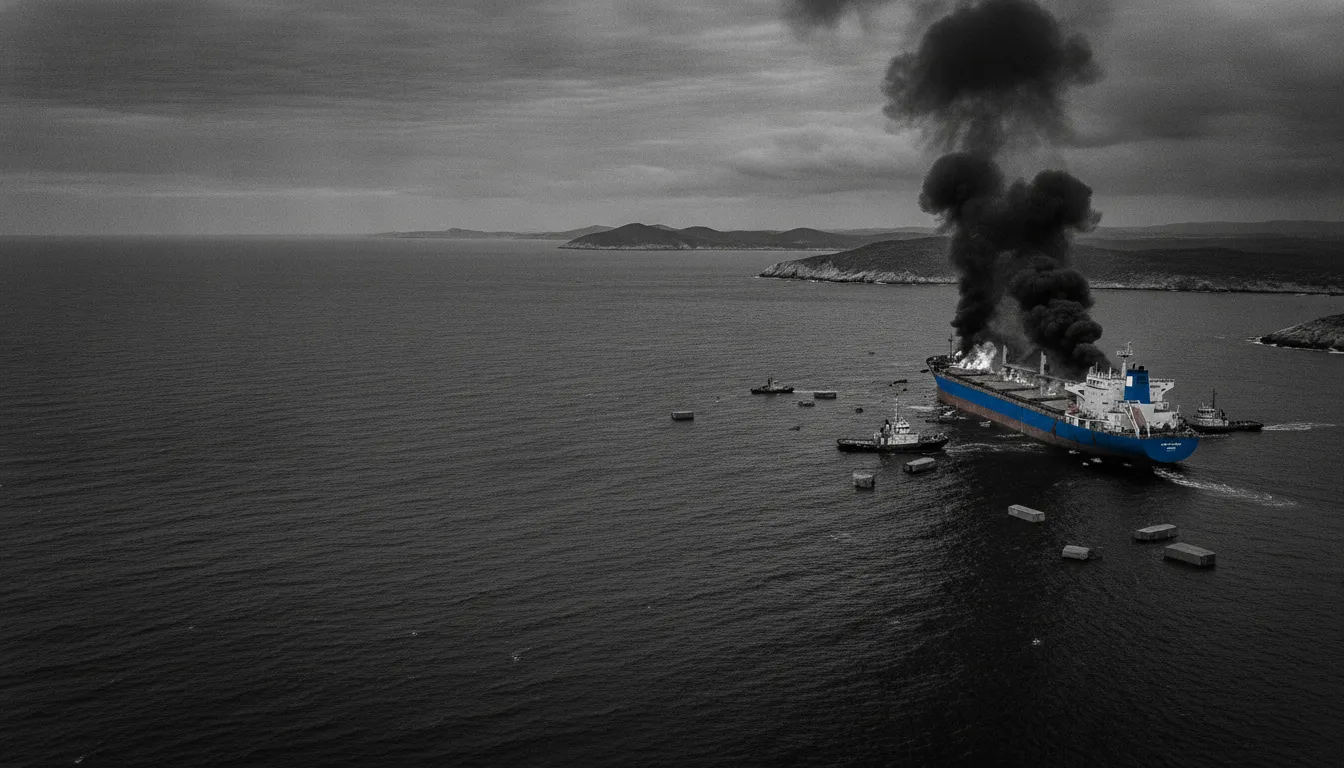
The rule operates at global scale. According to the World Shipping Council, approximately 250 million containers are transported annually, yet container losses remain statistically rare—representing only about 0.0002% of volumes. However, the consequences of even isolated losses are severe. A semi-submerged container becomes a navigational hazard for fishing boats, yachts, and coastal craft. Cargo spills damage sensitive shorelines. In 2024, 576 containers were lost—nearly triple the 221 lost in 2023, a spike driven partly by Red Sea geopolitical disruptions forcing operators to reroute around the Cape of Good Hope. Over a decade (2008–2021), an average of 1,300 containers were lost annually; 2024's figure, while elevated, remains below that historical mean. The mandatory reporting regime treats every loss equally: whether a single box slips overboard in benign conditions or a dozen cascade during heavy weather, the master must report immediately, creating the first standardised global dataset.
Reporting Obligations: The Chain of Command and Timing
The master must report container loss or sighting without delay by appropriate means—VHF, DSC, Inmarsat, or other radio systems—to three recipients simultaneously: nearby vessels in the vicinity, the nearest coastal state, and the ship's flag state. If the vessel is abandoned or unable to transmit, the operating company (as defined in SOLAS regulation IX/1.2) must assume reporting responsibility to the fullest extent possible. This shift places corporate accountability squarely on the company, not just the bridge, closing a loophole where damaged or disabled vessels previously escaped reporting altogether.
Critically, "without delay" means incomplete initial reports are acceptable and expected. The master must transmit available information immediately—UTC time, position, ship's identity (IMO number, name, call sign, MMSI), and approximate container count—rather than waiting for stowage surveys to confirm exact numbers. The IMO Circular CCC.1/Circ.7 provides a standardised template pre-loaded on modern bridges. Once investigators verify the final count through inspection, a follow-up marked "final" is submitted to the same recipients. This two-stage process prevents paralysis in crisis conditions—when bridge teams are stretched during heavy weather and visibility is poor—while ensuring eventual accuracy. Industry guidance emphasises that masters complying with "without delay" must send an incomplete initial report immediately; waiting for complete data before transmitting is itself non-compliant. The expectation is pragmatic: bridge teams act fast, update later.
Data Elements and Format: What the Report Must Contain
Reports must include: ship's identity, time and position (UTC), number of containers lost or estimated lost, container descriptions (size, type, loaded/empty status), and—critically—whether dangerous goods are involved, with UN numbers where known. Masters must also note wind speed and direction, sea state, cargo leakage, and projected drift patterns if available. For vessels observing drifting containers (rather than losing them), the report format is identical except for the message type, which specifies "observation" rather than "loss." All vessel types—tankers, bulk carriers, general cargo—have identical reporting duties when spotting drifting boxes; this broadens SMS requirements across entire fleets, not just container operators.
MARPOL Protocol I amendments (MEPC.384(81)) ensure that when containers carry harmful substances, the SOLAS report satisfies both SOLAS V/31–V/32 and MARPOL reporting obligations for the same incident, eliminating duplicate notifications. However, the additional cargo detail and UN numbers for hazardous goods must be included in the single submission. This integrated approach reduces administrative burden but demands precision in dangerous goods documentation and classification at loading. Any deficiency in hazardous goods reporting exposes operators to both safety and environmental liability, and port state control officers now scrutinise container manifests and cargo security manuals during inspections.
The Global Reporting Chain: Flag State to GISIS
Once the flag state receives the master's report, it must forward the incident to the IMO via the Global Integrated Shipping Information System (GISIS), a centralised database designed to create a public, global repository of container loss events. The flag state, not the vessel operator, uploads data to GISIS using the standard template. A dedicated GISIS module was created for these incidents, enabling real-time container loss data sharing among maritime authorities worldwide. This creates a transparent, auditable record that port state control officers can access during inspections, converting fragmented national reporting into unified global monitoring.
Unlike the previous voluntary era, non-reporting now constitutes a deficiency under SOLAS Chapter V, with enforcement teeth: port state control detentions, insurance claim complications, and reputational damage. For operators and managers, this means establishing direct communication protocols with flag state authorities and ensuring the company emergency procedures explicitly define who notifies the flag state and by what deadline. A delay in flag state notification cascades into a delayed GISIS entry, creating a compliance trail visible to future charterers and cargo interests. Digital systems that timestamp each handoff and automatically generate notifications reduce human error and prove compliance during PSC inspections. Given that GISIS records are accessible globally, every loss becomes a permanent part of the vessel's record, influencing charterer risk assessments and insurance underwriting.
Safety Management Systems and Bridge Team Readiness
All stakeholders—shipowners, operators, and managers—must have updated their Safety Management Systems (SMS) by now to incorporate the new SOLAS V/31–V/32 procedures. The SMS should designate specific personnel responsible for container loss reporting, define escalation paths, specify communication methods and contact details for flag states and coastal authorities, and establish protocols for initial and follow-up reporting. Bridge officers and masters must be trained in the reporting chain, the timing requirement (without delay), and the mandatory information fields.
Operators should conduct simulated container loss drills using realistic scenarios—heavy weather, communication system failures, incomplete information—to ensure crew can respond correctly under stress. Training must clarify that incomplete reporting is acceptable and expected; waiting for perfect data is non-compliant. The South African Maritime Safety Authority's experience in 2024 provides case studies: three major incidents near the Cape of Good Hope (involving 44, 46, and 99 containers respectively) occurred during winter storms when crews faced difficult conditions and communication delays. Yet reporting must still occur immediately. Many operators are integrating digital compliance platforms that pre-load IMO templates, automate notifications, create timestamped audit trails, and route reports through both SOLAS and MARPOL frameworks for containers carrying dangerous goods. These systems reduce cognitive load on bridge teams and ensure that critical information is transmitted even when manual procedures break down.
Enforcement, Insurance, and Commercial Risk
Non-compliance carries direct consequences. Port state control officers now inspect container loss reporting procedures as a SOLAS Chapter V deficiency. A vessel found with an unreported loss, or a loss report that does not meet V/31–V/32 standards, can be detained under Paris MoU and Tokyo MoU regimes. Detention disrupts schedules, cancels charters, and damages vessel reputation with cargo interests and terminal operators. Hull & Machinery insurance and Protection & Indemnity coverage may include clauses requiring compliance with mandatory reporting; failure to report can void coverage or trigger claim denials. For ship operators, such insurance implications are existential: a $50–200 million potential incident cost (vessel damage, cargo loss, delays) makes non-compliance a commercial as well as legal liability.
Brokers managing tonnage must ensure charter parties and contracts reflect the new regulatory reality. Disputes over who bears responsibility for reporting delays, who contacts the flag state, and who manages GISIS submissions should be clarified contractually. For supply chain managers and shippers, the mandatory reporting regime provides the first global, standardised visibility into container losses, enabling data-driven risk mitigation and cargo security planning. The World Shipping Council and the TopTier project—a joint industry initiative involving more than 40 stakeholders including flag states, shipping companies, and classification societies—are using these datasets to identify patterns and advise on better stowage, lashing software, weather routing, and container securing gear inspection programmes.
Operationalising Compliance: A Practical Roadmap
Operators should have completed the following by 1 January 2026 (or immediately if not yet done): review and revise SMS procedures to include V/31–V/32 workflows; provide bridge team training and competency sign-offs; test communication protocols with flag states and coastal authorities; establish clear company emergency contacts and escalation procedures; integrate IMO Circular CCC.1/Circ.7 templates into bridge systems (tablets, ECDIS, email); ensure P&I and H&M insurance policies cover new reporting obligations and clarify coverage terms; conduct simulated incident drills; and establish feedback loops so that reported losses inform future stowage, loading, and route-planning decisions. For operators managing fleets that route through high-risk areas like the Cape of Good Hope—where 2024's 191% traffic surge exposed vessels to hazardous winter conditions and resulted in 35% of annual global losses—enhanced weather routing, stricter lashing protocols, and pre-departure stowage validation become not just best practice but competitive necessity.
Brokers arranging tonnage should confirm that vessel operators have updated SMS and trained crews; include container loss reporting compliance in pre-fixture vetting questionnaires; and ensure charter parties clearly allocate reporting responsibilities. Digital systems providers have an opportunity to embed compliance workflows into existing SMS software, automating SOLAS and MARPOL notifications, timestamping audit trails, and generating compliance reports for PSC inspections and insurance audits. The competitive advantage will flow to operators and technology partners who treat mandatory reporting not as a checkbox but as a driver of operational intelligence and cargo security. What this means for you: the era of silent losses is over. Every incident is now documented, analysed, and visible to flag states, port authorities, insurers, and—through GISIS—the global maritime community. Operators who invest in training, digital systems, and root-cause analysis will differentiate themselves from those who treat compliance as paperwork. The smartest carriers are already using 2026 as a launchpad to prevent losses, not merely report them.