
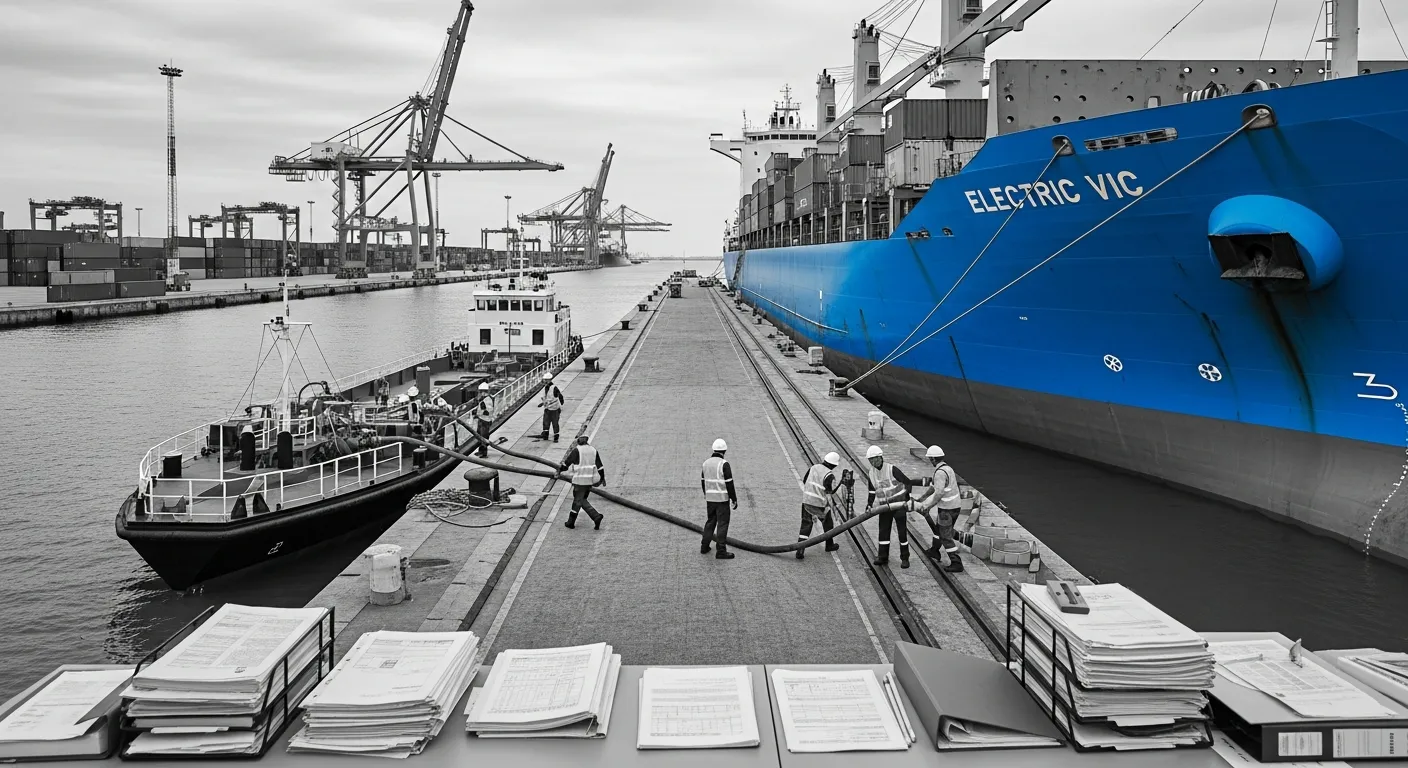
"2026 marks a crucial year in maritime industry regulation with numerous updates designed to curb greenhouse gas emissions and enhance environmental performance."
The Regulatory Convergence: Three Schemes, One Bunkering Event
The convergence of UK ETS, EU ETS full phase-in and FuelEU Maritime deadlines creates an unprecedented operational squeeze for agents and bunker suppliers. From 1 January 2026, the EU ETS moves from a 70% phase-in to 100% compliance, meaning ships must now surrender allowances for all verified CO₂, methane (CH₄) and nitrous oxide (N₂O) emissions from voyages between EU ports and while at berth. Simultaneously, from 1 July 2026, the UK ETS begins tracking domestic UK voyages for ships of 5,000 GT and above, requiring operators to monitor and report emissions under a separate national regime with its own allowance instrument (UKA, not EUA) and distinct procedural timelines.
FuelEU Maritime, which concluded its first reporting period on 31 December 2025, now enters its penalty phase. Between 31 January and 30 June 2026, shipper compliance balances are verified and penalties issued — forcing operators to reconcile their fuel consumption records with two simultaneous carbon pricing systems. A single vessel calling at London and Rotterdam may now face compliance obligations under UK ETS, EU ETS and FuelEU simultaneously, with no formal linking mechanism between the markets and potentially different allowance prices driving cost volatility.
The UK ETS Domestic Scope: Emissions Monitoring Plans and Allowance Surrender
The UK ETS applies to ships of 5,000 GT and above operating on domestic UK routes and in UK ports from 1 July 2026. Maritime operators must submit an emissions monitoring plan (EMP) within 42 days of commencing regulated activity and monitor CO₂, CH₄ and N₂O emissions on a voyage and annual basis. Verified annual emissions reports are due by 31 March 2027, with allowance surrender deferred to 30 April 2028 under a double-surrender arrangement that combines the 2026 and 2027 scheme years. For non-compliance, operators face a penalty of £100 per missing allowance, adjusted for inflation. The scheme applies 100% coverage to UK domestic voyages and in-port activities, but only 50% to voyages between Great Britain and Northern Ireland.
Unlike the EU ETS, the UK Authority has not mandated verifier-issued Documents of Compliance for UK ETS maritime. Compliance is instead managed through the Maritime Emissions Tracking System (METS) and the UK Emissions Trading Registry. This distinction creates a significant operational difference: agents must now manage parallel reporting workflows for UK-focused vessels using METS while simultaneously submitting EU ETS data through the THETIS-MRV platform for EU-port calls. The procedural divergence, combined with two distinct allowance markets with no price linkage, introduces additional complexity for cost allocation and hedge management.
EU ETS 100% Phase-In and CO₂e Accounting: Methane and Nitrous Oxide Enter the Compliance Picture
From 1 January 2026, the EU ETS reaches full compliance for all voyages between EU ports and 50% coverage for voyages between EU and non-EU ports. Critically, the scope has expanded beyond CO₂ to include methane and nitrous oxide on a CO₂-equivalent (CO₂e) basis. Bunker delivery notes, fuel consumption data and emissions calculations must now incorporate CO₂e factors that reflect the full lifecycle greenhouse gas intensity of the fuel, not merely its carbon content. Companies must implement workflows that can reliably calculate and track these emission factors to avoid discrepancies during third-party verification or allowance reconciliation.
Verified emissions reports must be submitted to the European Commission by 31 March 2026 for the 2025 compliance year, with allowances surrendered by 30 September 2026. Ships must carry a valid EU ETS Document of Compliance (DoC) by 30 June 2026. For agents and bunker brokers, this means every fuel bunkering transaction now requires not only a traditional BDN with sulphur content and quantity, but also supporting documentation for the CO₂e calculation — including fuel specification data, consumption records, and voyage logs. A single EEA port call creates a 100% monitoring obligation for all energy used at berth, even if the vessel's deep-sea voyages fall under the 50% phase.
FuelEU Maritime: Intensity Targets and the First Verification Penalty Phase
FuelEU Maritime imposes a progressive reduction target on the GHG intensity of energy used onboard. The first reduction target is 2% below the 2020 baseline of 91.16 gCO₂e/MJ, measured on a well-to-wake basis. Ships calling at any EU/EEA port must meet these intensity limits regardless of flag state. The ISM company (typically the technical manager) bears responsibility for compliance, but procurement teams buying bunker must understand the fuel-intensity implications: blending 15–25% used cooking oil (UCO) with very low sulphur fuel oil (VLSFO) is a common compliance strategy, incurring an estimated cost premium of €150–€300 per tonne.
The first compliance cycle ran through the first half of 2026, with reports due by 31 January, verification confirmation by 31 March, and penalties issued by 30 June. Non-compliance carries a fixed penalty of approximately EUR 2,400 per tonne of VLSFO-equivalent deficit. For agents and bunker suppliers, this creates an immediate data demand: every fuel transaction must now include a Proof of Sustainability (PoS) certificate if a biofuel or alternative fuel is supplied, along with mass-balance documentation and GHG emissions savings calculations demonstrating compliance with the EU's Renewable Energy Directive (RED II). Even a single EEA port call creates a reporting obligation for 50% of voyage energy and 100% of berth-side consumption.
Documentation Multiplication: BDNs, Attestations and Verification Workflows
The collision of three compliance regimes creates a tripling of documentary demand at the bunker supply point. A traditional bunker delivery note has historically captured fuel type, grade, sulphur content, quantity and delivery date. It now must also support: (1) UK ETS monitoring and reporting under METS, requiring voyage-specific fuel consumption records and emissions calculations; (2) EU ETS allowance allocation, demanding CO₂e factors, methane and nitrous oxide data, and verification-ready calculation trails; and (3) FuelEU Maritime intensity compliance, requiring PoS certificates, mass-balance traceability, and lifecycle GHG savings documentation.
Third-party verifiers must independently confirm all three data streams. Under EU ETS, accredited verifiers check emissions reports by 31 March each year against log abstracts, bunker delivery notes and external data sources. Under FuelEU, a separate verification confirms compliance balance by the same deadline. Under UK ETS, operators rely on METS and the UK Registry, but still require metrological consistency with the EU system for dual-jurisdiction operators. Agents and bunker brokers must now build IT infrastructure to capture, validate and transmit these datasets in parallel formats, store them for audit trails (bunker samples and BDNs must be retained onboard for three years), and reconcile discrepancies between systems when voyage-level calculations diverge.
What This Means for Procurement and Port Services
For ship suppliers and agents, the mid-2026 regulatory convergence demands immediate action in three areas. First, map your vessel fleet by jurisdiction and flag: identify which ships face UK ETS, EU ETS or both, and classify voyages by their emissions coverage percentage (100% intra-EU, 50% EU-non-EU, domestic UK). Second, build compliance data packs now: establish systems to capture and transmit fuel consumption, voyage records, emissions factors and verification documentation in parallel to multiple regulators. Invest in BDN digitisation and blockchain-backed fuel sample management to create audit trails that satisfy all three verifiers. Third, negotiate clear cost pass-through and allocation clauses in charter party and ship management agreements, specifying which party bears the cost and liability of allowance shortfalls, intensity penalties and fuel premiums. The difference between a managed strategy and an ignored one is typically the difference between a controlled OPEX line and a penalty invoice by mid-2027.


