For a vessel making regular UK calls, the split compliance obligation means two sets of accounts, two sets of purchases, and two sets of deadlines—but the UK side is currently the cheaper obligation.
Two Carbon Markets, One Supply Chain
From 1 January 2026, the EU ETS reached full implementation at 100% coverage, up from 70% in 2025 and 40% in 2024. This represents a watershed in maritime carbon regulation: shipping companies operating vessels of 5,000 GT and above on voyages touching EU or European Economic Area ports must now purchase and surrender European Union Allowances (EUAs) covering all verified emissions within scope. Simultaneously, on 1 July 2026, the UK launched its own standalone ETS for domestic maritime, applying to vessels of 5,000 GT and above engaged in UK voyages and port operations.
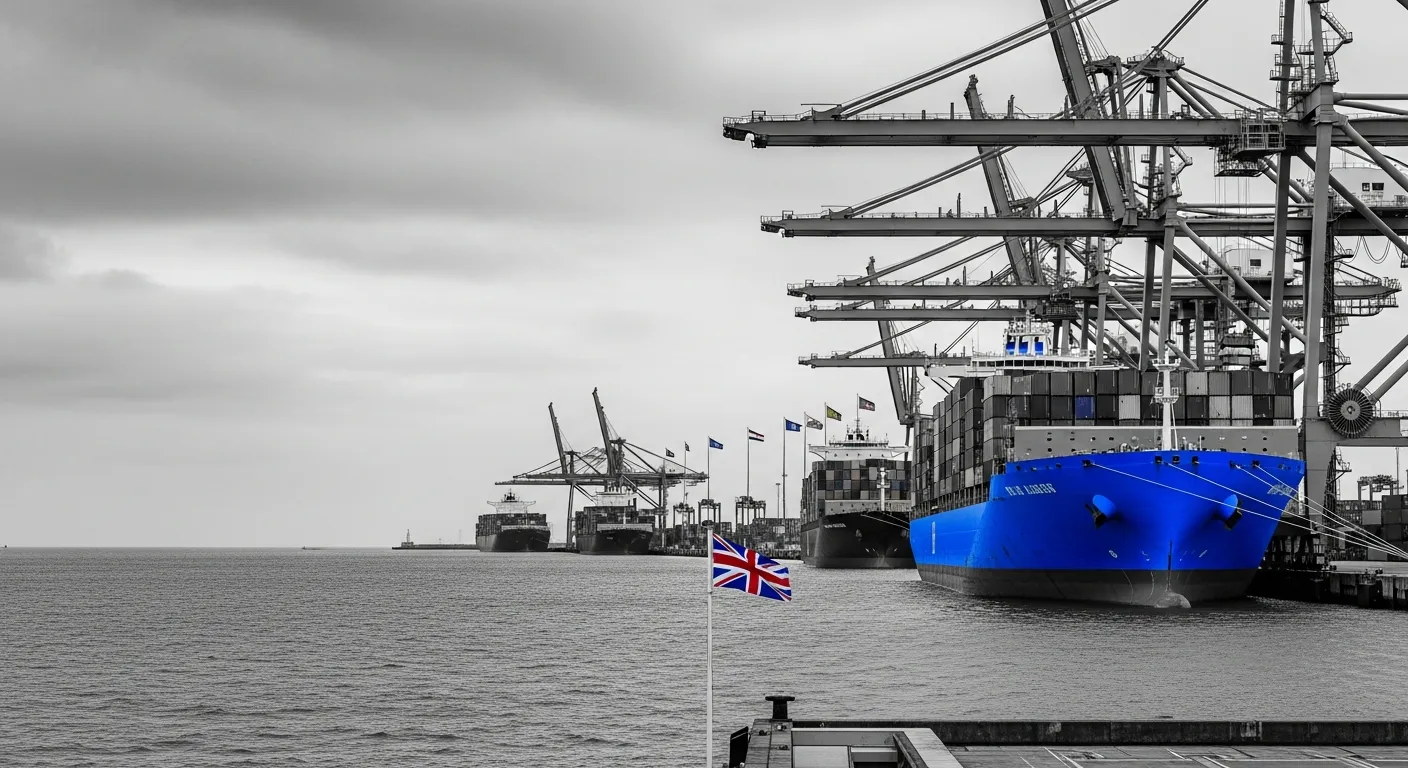
These are not linked systems. The UK ETS operates independently of the EU ETS using separate allowances (UKAs), distinct regulatory platforms (METS and the UK Registry versus THETIS-MRV and the EU Registry), and different surrender deadlines. For operators servicing ports on both sides of the Channel—including ferry companies, container carriers and ro-ro vessels—the compliance machinery has effectively doubled: two monitoring plans, two verified annual reports, two sets of allowance accounts and two cost-recovery mechanisms embedded in freight and supply contracts.
The Price Wedge: 30–40% Cost Differential
The commercial incentive to avoid either scheme is now material. UK carbon allowances traded in the £30–£55 range through 2025–2026, while EU allowances (EUAs) traded €65–€85 per tonne of CO2 equivalent over the same period. At current exchange rates, UK carbon is roughly 30–40% cheaper per tonne than EU carbon. For a container carrier planning rotations that include both UK and EU ports, this creates a route-design dilemma: calling Felixstowe first (UK in-port emissions at lower carbon cost) versus Rotterdam (full voyage coverage at higher EUA expense) can materially alter voyage economics and hence the bunker supply schedule.
The price differential also exposes brokers and suppliers to customer pressure. Charterers may demand that operators route via UK ports or defer EU port calls to reduce overall ETS exposure. This geographic arbitrage, while rational from a carbon-accounting perspective, fractures procurement cycles. Bunker agents in UK ports report increased hedging and forward-purchase inquiries as operators seek to lock in supply costs ahead of expected route changes. The regulatory frameworks themselves provide no parity mechanism—the UK Authority and EU Commission have not yet finalised any linking arrangement, despite a May 2025 commitment to explore technical compatibility.
Surrender Deadlines and the Documentation Blitz
The surrender deadlines create acute coordination challenges for ship suppliers and procurement teams. Under EU ETS, operators must surrender allowances by 30 September each year, based on emissions from the previous calendar year. Under UK ETS, the surrender deadline is 30 April of the year following the reporting period—one month after the Annual Emissions Report is due on 31 March. For the first two UK ETS scheme years (2026 and 2027), operators benefit from a one-time "double surrender" deferral: both 2026 and 2027 allowances are due by 30 April 2028.
This creates a cascading audit trail that ship suppliers must track independently. Bunker delivery notes, noon reports, voyage logs, port records and fuel consumption data must be segregated by scheme and jurisdiction. EU MRV-verified reports (due 31 March annually, surrender by 30 September) flow into the EU Registry; UK ETS Annual Emissions Reports (due 31 March, surrender by 30 April 2026–2027, then annually from 30 April 2028) must be submitted via METS and the UK Registry. Non-compliance carries penalties: €100 per missed EUA in the EU; port detention and reputational exposure under both schemes. For suppliers managing multiple customer accounts, the administrative overhead is material.
Methane, Nitrous Oxide and Emission Factor Creep
From 2026, both the EU ETS and UK ETS expanded their scope to include methane (CH₄) and nitrous oxide (N₂O) in addition to CO₂. This had an immediate cost impact. The EU adjusted emission factors upward: from 3.114 mtCO2e per tonne of heavy fuel oil in 2025 to 3.163 in 2026; from 3.151 for VLSFO to 3.200; from 3.206 for MGO to 3.255. These changes alone added approximately 1.6% to compliance costs for 2026. For LNG-fuelled vessels, which emit methane during extraction, transportation and bunkering (methane slip), the impact is more severe. Methane has a global warming potential 28 times higher than CO₂; nitrous oxide 228 times higher. Operators using LNG or other alt-fuel vessels now face materially higher allowance requirements per voyage.
Ship suppliers and bunker brokers must now advise customers on fuel choice with explicit reference to methane slip and resulting ETS liability. The EU ETS generated approximately €250,000–€300,000 in allowance costs per 10,000 TEU container ship per Busan–Rotterdam voyage in early 2026 at full phase-in; that cost is now higher due to expanded GHG scope. Suppliers are fielding detailed questions about sustainable fuels (rated zero-rated under tank-to-wake methodology) and biofuel blends that reduce ETS exposure at the point of procurement. The commercial conversation around bunker supply has shifted from price and sulphur content to carbon-accounting methodology.
Charterparty Clauses and Cost Pass-Through
Since both schemes impose cost obligations on "the shipping company"—defined as the vessel operator, whether owner or manager—the allocation of ETS liability between owners and time charterers has become a material negotiation point. In time-charter fixtures, the charterer customarily buys bunkers; the owner registers the vessel and holds the compliance obligation. ETS cost pass-through is increasingly written into charterparties as a separate line item, distinct from the traditional bunker recovery charge. Brokers and agents report that ETS clauses are now market-standard in new fixtures, but the mechanics differ: some contracts allocate the owner's surrender cost on a per-voyage basis; others use a quarterly true-up mechanism tied to published EUA and UKA prices.
For suppliers, this means invoicing and cost reconciliation workflows must segregate ETS-related charges from traditional bunker costs. If a supplier provides marine fuel in a UK port to a vessel that will subsequently call Rotterdam, the cost allocation now depends on contract interpretation: does the UK port bunker buyer bear the subsequent EU ETS liability? The legal exposure is real, and disputes over ETS cost allocation remain largely unresolved in arbitration. Suppliers are increasingly requiring customers to confirm ETS liability allocation in writing before fuel delivery.
Operational Response: Route Planning and Fuel Strategy
The industry response to dual-scheme compliance has begun. Some container carriers are trialling transshipment at non-EU hubs (such as Tangier or Jeddah) to reduce EU ETS exposure on the final leg into Europe. Others are accelerating investment in alternative fuels: sustainable fuels including biofuel blends are zero-rated under tank-to-wake methodology in both schemes, offering immediate ETS offset opportunity. Maersk announced plans for methanol-powered carbon-neutral liners by 2027; ferry operators are restructuring fleet composition to prioritise LNG and hybrid vessels, though Brittany Ferries reported an expected €27 million EU ETS bill for 2026 despite heavy capital investment in low-emission tonnage.
Speed optimisation and weather routing remain direct levers on bunker consumption and hence emissions liability. But these operational decisions now carry dual compliance implications: a slower passage reduces EU ETS exposure but may conflict with UK ETS berth-time assessments at the same port. Suppliers benefit from this complexity: customers increasingly seek real-time emissions dashboards, forward-cost estimates and scenario modelling (route A via UK versus route B via EU) to inform procurement and chartering decisions. Bunker brokers are repositioning as emissions advisors, integrating carbon cost into voyage estimation models alongside traditional bunker and canal costs.
What This Means for You
Ship suppliers and bunker brokers must treat the July 2026 dual-scheme launch as a structural shift in procurement operations, not an administrative exercise. Segregate EU and UK ETS data flows immediately; reconcile charterparty clauses for ETS cost allocation; engage customers on sustainable fuel optionality before voyages commence. The 30–40% price differential between UKA and EUA creates genuine route-planning arbitrage—and customer pressure to exploit it. Maintain separate allowance accounts, track surrender deadlines in your compliance calendars (30 April for UK ETS 2026–2027, 30 September for EU ETS annually), and ensure your verification and legal teams are aligned on cost pass-through mechanics. Operators who delay ETS integration into chartering and procurement workflows will face cost surprises and disputes. Those who embed emissions pricing into standard bunker quotations—transparent, documented and linked to published allowance prices—will retain customer trust and operational clarity in an era of parallel compliance obligations.